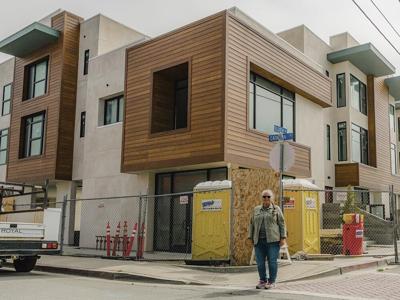

At approximately 347 acres, tiny Sand City doesn’t have much room to spare. That there is nearly an acre of land for each of its 372 residents is deceiving. The tiny town is hemmed in by protected coastal zone habitat and Monterey Bay to the west of Highway 1, shopping centers – the city’s main revenue source – to the north and its neighbor Seaside surrounding the rest. “The deal here in Sand City is we’re running out of room to build,” says Mayor Mary Ann Carbone.
And yet, when the Regional Housing Needs Allocation numbers were finalized in April, Sand City was told it would have to plan for 260 more homes, a 141-percent increase over existing units in the city. “That is patently unreasonable on its face,” City Manager Vibeke Norgaard says. Of the 260, 145 are required to be very low – to moderate-income housing.
Norgaard doesn’t blame officials at the Association of Monterey Bay Area Governments, which developed the RHNA numbers for the 2023-2031 time period, called Cycle 6, using formulas under the watchful eye of the state’s department of Housing and Community Development and with input from member cities and counties. But she fails to see how the formulas used to determine housing numbers for each city and county didn’t take into account real-world limitations.
Even the approved but yet-to-be-built South of Tioga project at 356 units will not help Sand City in meeting RHNA requirements, Norgaard says. That project was approved with 52 low-income units, which falls short of this affordability requirement.
The city further feels like it’s “between a rock and a hard place,” she says, because as HCD is requiring them to build more units, another agency – the department of Fish and Wildlife – has stalled the South of Tioga project over protection of a flower called the Monterey gilia, which resulted in reserving two acres of the city’s limited land for the endangered plant.
Norgaard appealed Sand City’s number to AMBAG in a letter on June 2. Greenfield also appealed its RHNA number – 730 units – on June 6.
Greenfield Community Development Director Paul Mugan and City Manager Paul Wood argued that their city has successfully overseen construction of housing under the current RHNA Cycle 5 requirements, reaching over 96 percent of its very low-income number, 170 percent of its low-income number and 100 percent of the moderate-income housing requirement. More housing projects are in the pipeline. Greenfield’s success means less land to meet the new “aggressive housing production targets,” they argued.
Mugan and Wood said the RHNA methodology should include adjustments for goals met in the previous cycle and asked for an adjustment or credit toward Cycle 6. “Such a carry-over credit is reasonable and fair,” they said.
The AMBAG board of directors will hear appeals in a public meeting on Aug. 10. The board is made up of 24 elected officials from cities in Monterey, Santa Cruz and San Benito counties, plus officials from each county government. Carbone of Sand City and Mayor Lance Walker of Greenfield both serve on the board, which means they will be recused from voting on their own cities’ appeals.


(0) comments
Welcome to the discussion.
Log In
Keep it Clean. Please avoid obscene, vulgar, lewd, racist or sexually-oriented language.
PLEASE TURN OFF YOUR CAPS LOCK.
Don't Threaten. Threats of harming another person will not be tolerated.
Be Truthful. Don't knowingly lie about anyone or anything.
Be Nice. No racism, sexism or any sort of -ism that is degrading to another person.
Be Proactive. Use the 'Report' link on each comment to let us know of abusive posts.
Share with Us. We'd love to hear eyewitness accounts, the history behind an article.