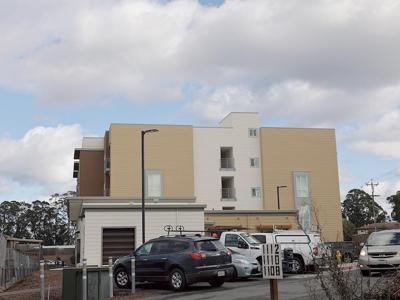

A MESSY DIVORCE IS PLAYING OUT IN MONTEREY COUNTY, not in a courtroom but in public meetings and behind the scenes of two agencies tasked with providing low-income housing. Meanwhile, the future of an 80-unit affordable senior apartment complex is on the line.
The mutually agreed-upon divorce proceeding is between the Housing Authority of the County of Monterey (HACM) and Monterey County Housing, Inc. (MCHI). Created by the Monterey County Board of Supervisors in 1941 to receive federal housing funds, HACM issues federal Section 8 housing vouchers and manages over 700 affordable units. MCHI (pronounced “Mee-Chee”) is a small nonprofit affordable housing developer that owns four apartment complexes in Salinas, Monterey and King City. It’s slated to build the senior apartments called Parkside II in Salinas.
MCHI and HACM have been intertwined since the beginning of MCHI, when it launched in 1989 and contracted all of its administrative, finance and property management services from HACM. MCHI, which was receiving U.S. Department of Housing and Urban Development funds, used those funds to purchase properties and develop affordable apartments. HACM provided property management upon completion and managed all of MCHI’s money.
In recent years, tension has been building between the two entities, leading to what MCHI Executive Director John Rose calls a “tipping point” that prompted MCHI to want to separate. During recent MCHI board meetings, President Nancy Lloyd said that HACM commingled rental revenues from both organizations, and despite repeated requests by her and Rose for a detailed accounting of MCHI’s revenues and expenses, none has been provided.
While the MCHI board is struggling to extricate itself from HACM, the nonprofit is now facing increasing scrutiny. MCHI was notified it does not qualify to receive HUD funds, which comes on the cusp of needing financing for Parkside II. Two years ago, its status with the California Franchise Tax Board was suspended. And now there are questions over its financial dealings, including the whereabouts of a $60,000 check.
SOME OF THE ACRIMONY BETWEEN THE AGENCIES stems from internal struggles and external pressures on HACM that came to a head a year ago, after several years of high turnover among top executives. (A new executive director, Zulieka Boykin from Alabama, was hired in October and began work the first week of December. She says it’s too early for her to comment on specifics.)
In 2021, HUD found the agency to be deficient in several areas. The Board of Supervisors threatened to step in and take over unless significant changes were made, mainly that HACM and its nonprofit development company, Housing Development Corporation, end a dysfunctional relationship by HDC coming back under the umbrella of HACM.
On Dec. 23, 2021, all seven HDC employees were terminated and simultaneously offered jobs at HACM. Former HDC executive director Starla Warren was offered a job, but would have been working under HACM’s executive director; she declined. She later filed a legal claim against HACM.
Employment battle aside, Warren is now involved in MCHI leadership. In June, she joined its board of directors. That raised some eyebrows – as a MCHI board member, Warren would be making decisions concerning her former employers, against whom she has an active claim.
Warren says she is able to keep things separate and has no animosity toward two HACM representatives who serve on the MCHI board, HACM Board President Jon Wizard and Monterey County Supervisor Wendy Root Askew. “I’ve been really reasonable about it, I’m not in any great hurry to jump into some fray or frying plan,” Warren says, just hours before a MCHI board meeting on Dec. 12.
During that meeting, she jumped.
THE VIRTUAL MEETING ON DEC. 12 turned out to be a contentious one, as Warren battled Wizard and Root Askew, ultimately leading to a 3-2 vote to remove them both from the MCHI board. She interrupted speakers and was clearly exasperated with Wizard and Root Askew, who both said they found proposed bylaw changes troubling.
In addition to booting both Wizard and Root Askew off the board ahead of a HACM/MCHI split, the changes also removed requirements that MCHI be subject to open meeting rules under California’s Brown Act, as well as the California Public Records Act.
Wizard and Root Askew questioned the changes.
“As we engage in a separation, our top priority must be to protect the safety and stability of the residents who are living in MCHI properties,” Root Askew said, adding that she didn’t believe the changes were legal or in the best interest of residents.
Another flashpoint was over the acceptance of a new board member, a former HACM employee, to fill a vacancy. Wizard argued that the board was violating its own bylaws that require representation on the board by people who are either low-income, live in a low-income neighborhood or represent an affordable housing organization.
Also objecting was Andrew Sandoval, representing League of United Latin American Citizens, LULAC, District 12. “All too often decisions are made by those that don’t reflect the community they’re making decisions for,” he said. (Sandoval says LULAC is actively recruiting residents of MCHI properties to serve on the board.)
Wizard and Root Askew were outvoted by MCHI board members 3-2, although they will remain on the board through February. That’s at the request of Warren, who asked that they broker a memorandum of understanding between MCHI and HACM regarding details of the split.
Wizard also raised questions about MCHI’s suspended status with the State Tax Franchise Board since 2020, and the whereabouts of a $60,000 title loan check made out to MCHI that was never deposited with HACM.
The questions prompted Root Askew to send a letter to the Monterey County District Attorney’s Office asking for a review of MCHI’s financial dealings.
Meanwhile, the 80-unit Parkside II project is likely going to be delayed to the disappointment of Salinas officials who hoped it would begin construction early in 2023. Rose says they are working on pulling financing together but “one of the problems we’re having right now is we can’t get solid financial information.”


(0) comments
Welcome to the discussion.
Log In
Keep it Clean. Please avoid obscene, vulgar, lewd, racist or sexually-oriented language.
PLEASE TURN OFF YOUR CAPS LOCK.
Don't Threaten. Threats of harming another person will not be tolerated.
Be Truthful. Don't knowingly lie about anyone or anything.
Be Nice. No racism, sexism or any sort of -ism that is degrading to another person.
Be Proactive. Use the 'Report' link on each comment to let us know of abusive posts.
Share with Us. We'd love to hear eyewitness accounts, the history behind an article.