
At the Monterey County Jail, Sheriff’s Chief Jim Bass has a stamp on his hand signifying he had his temperature taken before walking into work – it’s the new rule for all employees entering the jail, a daily temperature check to ensure they don’t have a fever before starting their shifts.
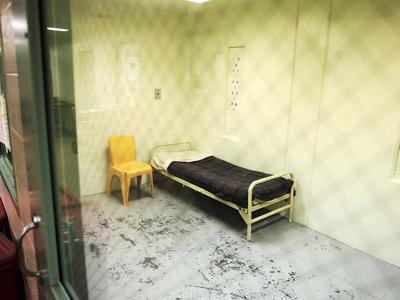
The same temperature checks, as well as questions about any possible symptoms indicating they might be carrying the Covid-19 virus, now apply for anyone arrested and transported to the jail. And once inside, new inmates are placed inside one of the six units that have been cleared out and reserved to quarantine them for 14 days to make sure that even though they might not be showing symptoms like a fever, they’re not carrying the virus into custody with them.
Those six units, out of a total of 31 units, can house 131 people and will serve as an isolation wing for that many, if necessary, if the virus spreads through the facility.
“If someone is suspected, they’re placed in a single cell and kept away from everyone. Anyone shows signs, we contact Natividad Medical Center and Public Health for testing,” Bass says. “The seven or eight (inmates) we’ve suspected might have it have all tested negative.”
“You’re in jail where social distancing is impossible.”
Even as Monterey County Superior Court operations have slowed, the system is moving to release people from the jail.
A group that includes representatives from the sheriff’s office, the Public Defender, the District Attorney, probation and the court system meets at least daily to identify prisoners who might be eligible for release.
Presiding Judge Julie Culver also issued new temporary rules on which prisoners can be released on their own recognizance. Some inmates have been given credit for time served and released, and some have been released and given a date to return later this year and finish their sentences.
In all, 24 such releases have taken place in the past week; among them was an inmate over the age of 60 who has an underlying medical condition involving his immune system.
On March 28, state Chief Justice Tani Cantil-Sakauye held an emergency meeting of the state Judicial Council via teleconference – so many listeners dialed in, it repeatedly crashed the call. Cantil-Sakauye and the council voted unanimously that defendants detained for a felony might have to wait up to seven days before appearing in court. The standard, pre-pandemic, was 48 hours.
“If you got arrested today, instead of getting to court on Thursday, you might have to wait until next Monday,” says defense attorney Steve Rease, a former president of California Attorneys for Criminal Justice. “Meanwhile, you’re in jail where social distancing is impossible. There are county health officers all over the state who have spoken publicly on how dangerous it is to have people remain in custody in the middle of this.”
Public Defender Sue Chapman says thus far, no defendant has had to wait past the previous statutory time limit to be seen by a judge, and felony arraignments are still five days a week. “We are targeting in-custody defendants so we can get them released,” Chapman says.



(0) comments
Welcome to the discussion.
Log In
Keep it Clean. Please avoid obscene, vulgar, lewd, racist or sexually-oriented language.
PLEASE TURN OFF YOUR CAPS LOCK.
Don't Threaten. Threats of harming another person will not be tolerated.
Be Truthful. Don't knowingly lie about anyone or anything.
Be Nice. No racism, sexism or any sort of -ism that is degrading to another person.
Be Proactive. Use the 'Report' link on each comment to let us know of abusive posts.
Share with Us. We'd love to hear eyewitness accounts, the history behind an article.