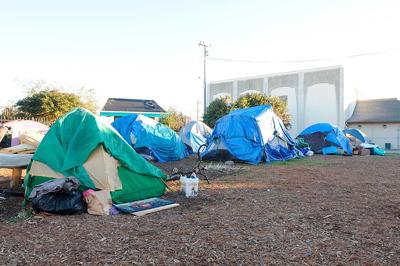

The tent city in Salinas’ Chinatown neighborhood is a patchwork of bright blues and dirty whites, the colors of tarps erected as homes. Makeshift structures line the railroad tracks that run through the city. On one lean-to, a spice rack is mounted, full of culinary seasonings, above a dug-out fire pit covered with a grate, forming a makeshift kitchen.
The homeless population in Salinas is growing. According to a bi-annual homeless census, 867 homeless people live in Salinas, a 63-percent increase since 2013.
Ed Frey, a Soquel-based attorney, is leveraging a footnote from a 20-year-old California Supreme Court case to try to transform this picture.
Since May, Frey has been seeking plaintiffs to join in lawsuits against Monterey, Santa Cruz and Santa Clara counties. He plans to file the first of three lawsuits in Santa Cruz County Superior Court on Aug. 6.
Four plaintiffs – Lucero Luna, Michael Grady, Christopher Joslyn and Michael Ohre – are homeless in Santa Cruz County. A reverend and a rabbi join them as plaintiffs in the suit against the Health Services Agency of Santa Cruz County.
Santa Cruz Assistant County Counsel Marie Costa declined to comment because the lawsuit hadn’t yet been filed.
A subsequent complaint against the Monterey County Health Department, with the same legal argument, is expected as early as next week. Two homeless men, John Thomas Grogan III of Seaside and Dwayne Diaz of Salinas, have agreed to be plaintiffs in the case.
Salinas Public Works, along with the County Department of Social Services and nonprofit Shelter Outreach Plus, opened a warming shelter last November, providing a place for up to 60 people to sleep during the winter, from 7pm to 6am. It’s the type of facility that could solve the problem, if scaled up.
Frey is banking on that footnote from a 1995 California Supreme Court decision, Tobe v. City of Santa Ana, as his key to forcing counties, rather than cities, to provide a place to sleep.
“If the inability of petitioners and other homeless persons in Santa Ana to afford housing accounts for their need to ‘camp’ on public property, their recourse lies not with the city, but with the county,” according to footnote 18.
Frey’s goal is to take the case all the way to the appellate court, hoping for a precedent-setting decision that would change the situation for California’s homeless.
“If it’s not legal to sleep unless you have property,” he says, “that’s a helluva situation to be in.”





(0) comments
Welcome to the discussion.
Log In
Keep it Clean. Please avoid obscene, vulgar, lewd, racist or sexually-oriented language.
PLEASE TURN OFF YOUR CAPS LOCK.
Don't Threaten. Threats of harming another person will not be tolerated.
Be Truthful. Don't knowingly lie about anyone or anything.
Be Nice. No racism, sexism or any sort of -ism that is degrading to another person.
Be Proactive. Use the 'Report' link on each comment to let us know of abusive posts.
Share with Us. We'd love to hear eyewitness accounts, the history behind an article.