::Quiet Crusader::Morley Brown

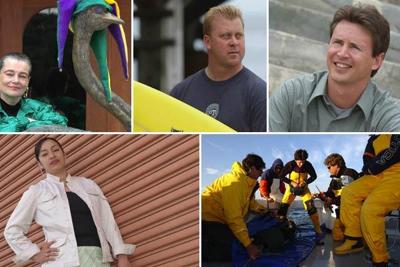
Gracious Goodness: Morley Brown, in front of her Carmel home, is as genuine as she is generous with her good deeds. Photo by Jane Morba
By Brett Wilbur
She’s on the board of practically every major (and minor) charity in Monterey County. She’s the perpetual winner of the Weekly’s annual “Best Local Do-Gooder” award. She lends out her home to virtual strangers for nonprofit events. But trying to find out who Morley Brown is difficult.
“There is nothing worse for me than talking about myself,” she says. “It’s worse than a root canal.”
But even when she’s not talking, it’s easy to see her enormously giving side.
When, on a late Tuesday afternoon, I ask her if we can reschedule our meeting from her Carmel home to the Weekly’s Seaside offices, she pauses for only a millisecond before answering.
“I wonder how I’m going to pack up the wine and hors d’oeuvres,” she says, mostly to herself. “If we’re at your offices, you can’t drink, I don’t want to get you in trouble. I’ll bring you some cold drinks.”
She arrives bringing a platter of homemade appetizers, dipping sauces, and a selection of nonalcoholic beverages. Plus, a statue of a dancer that she thought would provide deadline inspiration.
She brushes off my thank yous.
“You have to eat,” she says.
But I soon discover she has ulterior motives. With my mouth full of chicken apple sausage and shrimp, it’s difficult to prod her with questions. She takes advantage of the situation to turn the conversation completely off of her.
I manage to glean that she was raised in Great Falls, Montana, and that her parents, at a very young age, “modeled helping those less fortunate.”
“I joined my first board when I was 19,” she says. “It was the American Heart Association in Great Falls.
“My passion is trying to help people who can’t help themselves and really have no voice,” she says. “I physically and mentally hurt when people don’t have the basic needs: food, clothing, shelter.”
Brown hands me a piece of paper. On it are some sayings she has taped in her bedroom, which she says she looks at each day. One, she says, is from the 14th Dalai Lama: “Our beliefs as well as our action must come from the heart, for in our hearts the true wisdom that frees us and the path of compassion are inseparable.”
She lights up as she talks about her work. Last year, she says, a fellow board member at a local charity lost her husband and home, and suddenly found herself on the receiving end of the very charity that she worked for. (Citing privacy concerns, she declines to share the name of the friend or the charity.) After moving in with Brown for six months, receiving pro bono legal aid, counseling, and job training, the woman was able to find a job she loved.
“I watched her put her life back together,” Brown says.
Through another charity, the Alliance on Aging’s HomeShare program, the woman found a housing situation in a Pebble Beach home with an 88-year-old man.
“She makes him sandwiches, things like that,” Brown says. “They are mutually helpful and ecstatic to be together in what is like a father and daughter relationship.”
Brown also tells of a situation in which a formerly homeless man, through the help of local nonprofit Shelter Outreach Plus, is now an employee of the charity’s I-Help program.
“I have seen many people who are not mentally or physically able to pull themselves together,” she says. “But so often the working poor, with a little help, are able to get their feet on the ground.”
She leans across the table and stares at me intently. “Many of us are one mortgage payment away from being homeless,” she says. “I say so often, ‘there but for the grace of God go I.’ But we live in a beautiful, generous community.”
::Rescue Surfer::Kelly Sorensen

Wax On: Kelly Sorenson plucked surfers out of a mammoth wash like flies out of the air. Photo by Jane Morba
By Ryan Masters
March 9, 2005, will be remembered as one of the great days in big wave surfing history. It’s the day that Ghost Tree, the infamous big wave break off of Pebble Beach, made an indelible mark on the surfing world’s map by serving up some of the biggest waves ridden anywhere on the planet.
And while all of the glory may have gone to the handful of surfers who rode the 50-foot beasts, there was one man out on the water that day who risked his life not for the cameras or the thrill of the ride, but simply in the interests of safety.
Kelly Sorensen has owned and operated On The Beach Surf Shop for almost 20 years. He’s a big man with equal parts business sense and wave sense. A lifelong surfer with a taste for big waves, he was one of the first to make the leap to tow surfing—which allows surfers to ride waves the size of six-story buildings with the aid of personal water craft (PWC).
In 1999, Sorensen joined the Pacific Grove Ocean Rescue Team and began volunteering to do water patrol every year for the Pacific Grove triathlon. Then in 2001, Sorensen met Shawn Alladio at Maverick’s, the legendary Half Moon Bay big wave. Alladio has been a vocal advocate of PWC safety and legislation for over a decade and her K38 safety courses have helped define the sport of tow surfing. Concerned with the rising popularity of tow surfing and the sheer number of vessels and surfers in the water, Sorenson took Alladio’s course—training that proved itself invaluable when Ghost Tree went off this spring.
Early on the morning of March 9, Sorensen was one of the first people on the scene. Alone, he stood at Pescadero Point and watched the ocean rear up and repeatedly hurl itself with a terrible roar into Stillwater Cove. It was going to be a big day and, with all the media attention the spot had recently received, it was going to be crowded. The lineup wasn’t going to need another surfer, Sorenson surmised, it was going to need some dedicated water patrol. He climbed back into his truck and went back to Monterey to launch his PWC from the breakwater.
Sorensen’s instincts couldn’t have been better. March 9 proved both glorious and nearly fatal. Carmel native Don Curry caught a wave that nearly won the 2004/2005 Billabong XXL award for the biggest in the world, while Australian Justen Allport had his leg broken in four places. Through it all, Sorensen patrolled the impact zone, picking up stranded surfers and managing traffic.
Then, early in the afternoon, Santa Cruz pro Russell Smith towed his brother, Tyler, into a monster. Tyler styled straight down the thing’s massive face before Ghost Tree dropped a 50-foot axe on him.
When Tyler’s brother was blown off his PWC trying to save him, Sorensen raced into the chaotic impact zone to save both brothers. Thanks to Sorensen’s training and nerves, Tyler suffered only a strained rotator cuff and the Smith boys lived to ride another day.
::The Bird Man::Kelly Sorenson

For the Birds: Kelly Sorenson lives to see his dreams—and endangered raptors—take flight. Photo by Jane Morba.
By Eric Johnson
Not long ago, the California condor was widely thought to be doomed. The bald eagle had been eliminated from the skies in this part of the state. There were virtually no peregrine falcons. And the worst of it was that almost nobody cared.
Things have changed, and Kelly Sorenson, executive director of the Ventana Wilderness Society (VWS), is part of the reason. On its own and with the help of state and federal agencies, VWS has brought these awe-inspiring creatures back to Central California in healthy numbers. It is one of the happiest stories of wildlife recovery in the world.
Sorenson’s is the classic story, the kind that people who have followed their dreams get to tell. As a high school kid in West Virginia, he came across a pair of red-tailed hawks in some woods near his home. He was taken by their beauty and began photographing them—returning to their nest to create a photographic documentary. This grew into a passion for critters—and the hunting birds known as raptors in particular.
At the time, he was working in a hardware store, and a fellow worker knew about a place called the West Virginia Raptor Rehabilitation Center, where injured and orphaned birds were doctored and then released. Sorenson began volunteering there.
“I latched onto it,” he recalls. “Not just the birds and bird conservation, but the whole idea of the nonprofit. I ended up staying for five years.”
It was during that time that he made his first trip to Big Sur, to volunteer in a summer internship with VWS. Imagine: raptor-loving nature boy, deep in the California wilderness, releasing bald eagles from cages to live in the wild.
“The summer stretched into December,” he says. “I just absolutely fell in love with the place.”
He returned home to enroll in the wildlife management and fisheries program at West Virginia University. He was apparently in no hurry to complete his studies. “I was there in ‘88, ‘89, ‘90, and so on, and so on, all the way until 1995,” he says with a laugh. Most summers, he came back to Big Sur. And when he finally graduated, he came back for good. This is where the story turns into the kind about the dream come true.
At the time, the US Fish and Wildlife Service was engaged in an effort to save the condor by breeding the last surviving birds in captivity. The agency asked VWS to manage the release of the captive-bred birds into the wild. And Sal Lucido, then head of VWS’ board of directors, asked Sorenson, fresh out of college, to run the program.
“I told him I needed some time to think about it,” Sorenson says. “And in the next breath I said, ‘Okay!’”
Eight years later, Sorenson was asked to take over the reins of the organization. And now, packing a masters in public administration that he picked up in his spare time, he is engaged in an ambitious plan to broaden VWS’s programs in order to fulfill its mission of the “conservancy of wildlife and their habitats.”
::Barrio Warrior::Shi Cota

Cota Honor: Shi Cota finds peace in helping others heal as she heals herself. Photo by Jane Morba
By Jessica Lyons
When Shi Cota was a little girl, she dreamed about growing up to be a veterinarian. “I wanted to help animals,” says the 29-year-old Salinas native.
As an elementary school kid, Cota and her brother would hang out at Maple Park and rescue injured or lost animals—baby birds that had fallen from their nests or dogs and cats that had been hit by cars.
She says she still helps animals—just yesterday, she took a kitten to the SPCA. But in her early 20s, Cota realized that she could use her life experiences to help people, too.
“When I went through my life,” she says, “with the choices I made, drugs and gangs, when I got out of it, I decided to help people instead of animals.”
By the time she was 14, Cota says, she was already involved with gangs. She says that her father was also a gang member, in and out of prison from the time she was five years old. Raising Cota and her five siblings fell to Cota’s mother.
“Usually, we had a one bedroom apartment,” Cota says. “We didn’t have a lot of money. We needed more attention, but my mom couldn’t give that to us, so the gang met our needs.”
Now, 15 years later, Cota works as an intervention specialist for Second Chance in Salinas, a nonprofit gang prevention and intervention group. Local schools call Cota if there’s a gang fight on campus, or if a student is killed in a car accident. Cota comes in and talks to the kids; sometimes she does conflict resolution work and sometimes she just listens to them and shares her own experience. She’s a “Grief Buster,” trained through CHOMP to help those who have lost someone to suicide or sudden death.
Cota, along with a teacher at Everett Alvarez High School, meets with a group of about 30 high school kids called “East Side Raza” every other week. The students elect a president, vice president, secretary and treasurer, and host guest speakers.
“We talk about grief, we let them vent, and we give them the tools to change,” Cota says. “We ask them, ‘How are you feeling today?’ They say, ‘I feel depressed,’ so we talk about it. People need to support each other. That’s what we do.”
And at least once a week, Cota gives presentations—to students, parents, teachers, social workers and attorneys—about her own experience on the streets. She recalls that in one week when she was 22 years old, a friend was killed, her brother was locked up, and another friend was shot. “I was homeless, I was on drugs, I had a three-year-old running around me and I was pregnant. I was suicidal. I said, ‘I need something else.’”
Cota got out. She entered a drug rehab program and therapy.
“We tell kids we believe in them,” she says, “and that there’s a better life than getting involved in gangs. They think that’s the only way of life. We tell them they can actually break the chain. I did.”
This fall, she starts psychology classes at Hartnell College.
“I’m taking it slowly,” she says. “I’ve healed. I forgave a lot of people. That’s where I find peace.”
::Underwater Scientist::Barbara Block

Tuna Helper: Barabara Block advances conservation through innovation. Courtesy Stanford University
By Ryan Masters
"Bluefin tuna are recently evolved,” says Dr. Barbara Block. “They’re as new on earth as primates. They are a spectacular radiation of highly evolved fish.”
They are also on the brink of being fished into extinction. A full-grown bluefin tuna can fetch anywhere from $50,000 to $60,000 on the current market.
Over the past decade, a team of researchers led by Block has mapped the animals’ complex system of migration, showing how the conservation of populations in different parts of the world’s oceans are intrinsically linked and vital to the health of the bluefin population as a whole.
Block made international news this spring when she released the findings of an unprecedented study of bluefin tuna migrations. By fastening tags onto the wild fish, which tracked their movements as they traveled thousands of miles across the sea, to depths below 3,000 feet, Block and her colleagues were able to provide concrete data about these mysterious animals.
Dr. Block’s passion for the animals she refers to as “the pinnacle of fish evolution” can be traced back to her days as a student of legendary biologist Frank Carey—a man she calls the “father of tuna biology.”
“I was interested in how animals work and the fact that these fish are warm—they’re endothermic, which gives them the ability to actually move across these deep ocean basins,” she says. “They have this spectacular physiology. They’re like the Olympians of the ocean.”
Captivated by the mysteries of these giant fish, Block contributed to Carey’s research, including his pioneering tracking research.
When Block arrived at Stanford’s Hopkins Marine Station at Pacific Grove in 1993 and founded the Tuna Research and Conservation Center the following year, she created the first land-based tuna holding facility in the world, which allowed biologists to study the fascinating animals up close.
Then, in concert with a small team of Hopkins and Monterey Bay Aquarium staff, Block helped a dedicated team of engineers develop the fish tagging technology which has made her migratory research possible.
“These tools have allowed us to explore the unexplored parts of the planet,” she says. “We’ve learned so much about how far and how fast these magnificent fish are capable of traveling. They don’t come to the surface. We can’t use radio telemetry. These tags don’t talk to satellites. They rely on computers which calculate sunrise and sunset.”
Block and her team have recently developed the Tagging of Pacific Pelagic (TOPP) project. With live tracking of many of the 1,600 animals they’ve tagged over the last three to four years, the TOPP website (www.toppcensus.org) is a live, at-a-glance diagram of how the ocean is working from an apex predator’s viewpoint.
“We’re providing the best—and really the only—data for these fish,” Block says. “There are at least 60 nations fishing for bluefin tuna. If a bluefin tuna can disappear, that says a whole lot about the state of the ocean.”


(0) comments
Welcome to the discussion.
Log In
Keep it Clean. Please avoid obscene, vulgar, lewd, racist or sexually-oriented language.
PLEASE TURN OFF YOUR CAPS LOCK.
Don't Threaten. Threats of harming another person will not be tolerated.
Be Truthful. Don't knowingly lie about anyone or anything.
Be Nice. No racism, sexism or any sort of -ism that is degrading to another person.
Be Proactive. Use the 'Report' link on each comment to let us know of abusive posts.
Share with Us. We'd love to hear eyewitness accounts, the history behind an article.