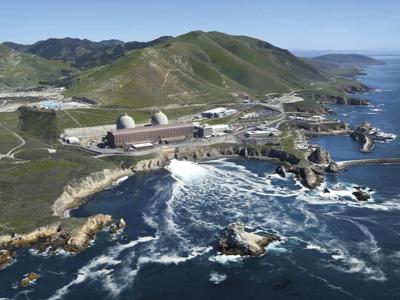

What began with a pitch by two former U.S. energy secretaries in a Los Angeles Times op-ed in November 2021 has snowballed into a contentious scramble by federal and state officials to potentially break a 6-year-old agreement and significantly shift California’s energy portfolio into the next decade.
The pitch from the two former U.S. energy czars was relatively simple: The state should reverse a 2016 agreement and work to keep the Diablo Canyon Power Plant in San Luis Obispo County open instead of decommissioning the nuclear reactors as scheduled in 2024 and 2025. Owned and operated by PG&E, Diablo Canyon today produces 8.5 percent of California’s electricity generation and about 15 percent of its renewable energy output – enough electricity to power 3 million homes.
At the time, the premise reflected a larger shift in U.S. nuclear politics, a shift driven in large part by the demands of the climate crisis and the volatility of solar and wind power. Many have warmed up to nuclear energy as a candidate due to its reliability and carbon-free process. However, the inherent safety risks and memories of nuclear disasters in Chernobyl and Fukushima loom large and make it a contentious issue.
By April 2022, the Biden Administration staked its position in the nuclear debate by opening up the application process for a $6 billion purse to save nuclear power plants across the country. Also that month, Gov. Gavin Newsom made his first public call to reconsider Diablo Canyon’s closure. Then, Newsom put taxpayer money where his mouth was: in the state’s $308 billion budget signed on June 30 there is a $75 million strategic reserve to finance the start of a Diablo Canyon extension – in the event that state and federal regulators move forward with a Diablo Canyon extension. That same day, the U.S. Department of Energy offered PG&E a 60-day extension beyond its July 5 deadline so that the utility could apply for federal nuclear funding to keep Diablo Canyon open.
Keeping the plant open would require three-party consent between the state legislature, federal regulators and PG&E. State Sen. John Laird says he is unsure whether there is enough momentum for the legislature to approve any measure to do so. At a minimum, Laird – whose district now includes SLO County – would like to see a public engagement process as robust as the one that preceded the decision to close the plant.
The work to extend a nuclear power plant’s life is highly complex and would require more than political approvals. During a June 22 meeting of the Diablo Canyon Independent Safety Committee, chair Robert Budnitz said the effort to shut down Diablo Canyon’s two reactors has been underway for years; reversing that work so the power plant is operational in 2026 is going to be a “tough technical challenge.”
“It’s still feasible, but it ain’t going to be feasible if that decision is made just before [the decommissioning deadline],” he said. “Two or three years is barely enough time.”



(0) comments
Welcome to the discussion.
Log In
Keep it Clean. Please avoid obscene, vulgar, lewd, racist or sexually-oriented language.
PLEASE TURN OFF YOUR CAPS LOCK.
Don't Threaten. Threats of harming another person will not be tolerated.
Be Truthful. Don't knowingly lie about anyone or anything.
Be Nice. No racism, sexism or any sort of -ism that is degrading to another person.
Be Proactive. Use the 'Report' link on each comment to let us know of abusive posts.
Share with Us. We'd love to hear eyewitness accounts, the history behind an article.