Back in the ‘30s and ‘40s, Western music spread across the United States faster than a Pony Express horse. Western music, which was a precursor to country and western, used folk ballads to tell the stories of rural life in America’s West. The music form spread past the borders of the West through radio programs like the National Barn Dance, a Hee Haw-like potluck of music, comedy and theater that launched the careers of acts like the comedy duo Amos and Andy.
During the ‘30s and ‘40s, The Sons of the Pioneers were the most well-known practitioners of Western music. They were popular for their harmony vocals, their superb playing and their songwriting, which yielded hits like “Cool Water” and “Tumblin’ Tumbleweeds.” Their compositions also scored classic Western films like John Ford’s 1950 release Rio Grande and the 1956 classic The Searchers. Closely associated with the budding Western film industry, one of their members, Leonard Slye, left the group to pursue an acting career as Roy Rogers.
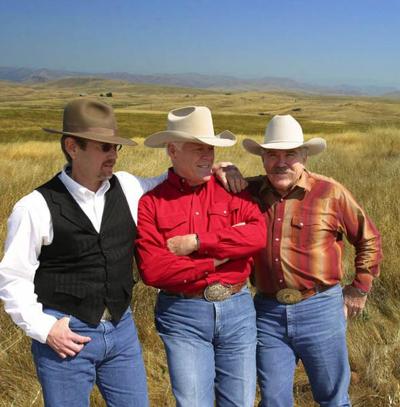
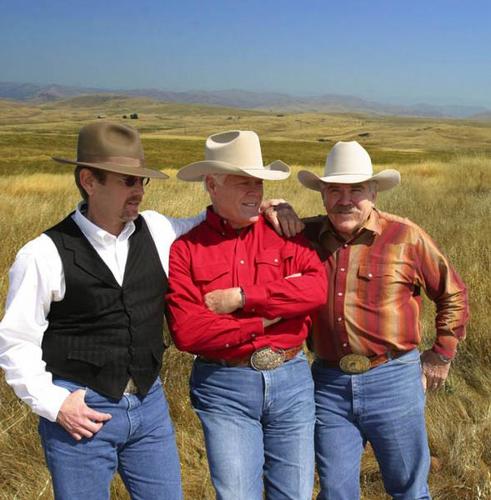
Currently, the Western group The Sons of the San Joaquin are committed to keeping the style of music created by The Sons of the Pioneers alive. Lon Hannah, one of the three Hannahs in The Sons of the San Joaquin, gushes about the early incarnation of The Sons of the Pioneers in his band’s bio. “When the Sons of the Pioneers were a trio with Roy Rogers, Tim Spencer and Bob Nolan, there was an innocence and exuberance to their sound that was just incredible,” he says. “We try to incorporate that emotion and feeling that the earlier trio had.”
Lon’s father Joe and Joe’s brother Jack grew up listening to The Sons of the Pioneers in California’s Central Valley. But though the two learned to harmonize in church, they were drawn away from their passion for western music by another all-American pursuit: baseball. Between 1950 and 1962, Joe was catcher for the Chicago Cubs, while Jack was a pitcher in the then-Milwaukee Braves’ farm system.
Following their professional baseball career, the two brothers worked in the school system—Jack as a high school counselor and Joe as a junior high teacher. Both also coached school sports teams.
It was Lon who spurred the formation of The Sons of the San Joaquin in 1987 by convincing his dad and uncle to join him at a performance for his granddad’s birthday. The next year, the trio secured an even bigger engagement when they were invited to play the 1989 National Cowboy Poetry Gathering in Elko, Nevada. Since that gig, the group has graced many stages and preformed on the live music television show Austin City Limits.
On their first CDs, A Cowboy Has To Sing and Songs of the Silver Screen, The Sons of the San Joaquin tipped their ten-gallon hats to their musical idols, The Sons of the Pioneers. But by the band’s third release, From Whence Came the Cowboy, Jack was penning original material for the group. They have also branched out with gospel and Christmas albums.
Now, The Sons of the San Joaquin’s own work is garnering accolades, especially their latest release, 2005’s Way Out Yonder. The CD allowed The Sons of the San Joaquin to take home the 2005 Western Heritage Award for Outstanding Traditional Western Album from the Cowboy Hall of Fame.
Way Out Yonder features tunes like “There’s a Rainbow Over the Range,” which mythologizes the landscape of the American West and ensures that cowboy phrases like “yippy yi yo” don’t disappear from the American vernacular. It also includes compositions like “Song from Nara Visa,” which starts off sounding as lonesome as the sight of a sole tumbleweed rolling across a vacant desert landscape. The band still pays tribute to the forefathers by covering Gene Autry’s “Mexicali Rose.” Meanwhile, the original “The Ballad of Joaquin Murrieta,” a song about California’s own Robin Hood-like character, is a classic example of a western story-song.
The Central Valley-based Hannah family also lives the lifestyle they promote in song. All of the Hannahs are seasoned horsemen. Jack even works at ranches and has been known to rope a steer or two.
THE SONS OF THE SAN JOAQUIN perform at the Annual California Cowboy Show, a fundraiser for the Carmel Valley Historical Society, with cowboy poet Clem Albertoni and musicians Bruce and Pam Forman at the Hidden Valley Theater, 88 Carmel Valley Rd. in Carmel Valley, this Saturday at 8pm. $35. 659-2038.



(0) comments
Welcome to the discussion.
Log In
Keep it Clean. Please avoid obscene, vulgar, lewd, racist or sexually-oriented language.
PLEASE TURN OFF YOUR CAPS LOCK.
Don't Threaten. Threats of harming another person will not be tolerated.
Be Truthful. Don't knowingly lie about anyone or anything.
Be Nice. No racism, sexism or any sort of -ism that is degrading to another person.
Be Proactive. Use the 'Report' link on each comment to let us know of abusive posts.
Share with Us. We'd love to hear eyewitness accounts, the history behind an article.