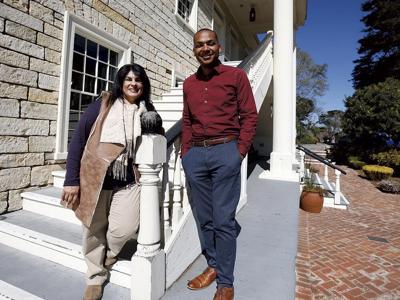

As rents have skyrocketed locally in recent years because demand for housing has far outpaced the rate at which new units get built, Monterey housing activist Esther Malkin has kept banging the drum. Even if those in power didn’t want to hear it at first, eventually, they had no choice: Malkin has been relentless – both in written and public comments to Monterey staff and councilmembers – over the last few years, while at the same time rents just kept going up.
Malkin finally found a staunch ally on the City Council in Tyller Williamson, who was elected in 2018, and who is considerably younger than his colleagues. While Williamson is a homeowner, he recognizes that, in a city where nearly two thirds of the residents are renters – and where all five members of City Council are homeowners, and some also own other properties – someone needs to represent the interests of the majority of the residents.
“I’m trying to use my place of privilege to address something I see as a huge problem,” Williamson says. He adds that he hopes the district-based council elections in the city, which will commence this November, will usher in a more representative democracy.
Their work is at least in part why the Monterey City Council held a meeting on Feb. 23 to study the possibility of creating a city-administered rental registry, which would require landlords to register their rental units with the city, including data about price, size, etc., while also paying a fee of about $66 per unit annually to do so. (Monterey city staff estimates it would cost about $400,000 annually to maintain the registry, and that cost would be borne by the landlords and perhaps passed onto renters.)
Though the registry itself is not a rent control measure – it’s merely a data-gathering tool – the city’s report concludes with, “starting the work on a rental registry could foreseeably lead council to consider further measures with respect to rent control and subsequent enforcement actions.”
From the outset of the meeting, the majority of the council did not express enthusiasm. Mainly, their objections were to creating a program that would cost $400,000 annually and produce only data, and not housing.
Citing the Fort Ord Reuse Authority as an example, Mayor Clyde Roberson said, “Once you establish a bureaucracy, they’re hard to get rid of.”
Williamson, seeing a lack of support from any of his colleagues, agreed with those who said the registry would not be a “silver bullet,” but added: “To me this is kind of low-hanging fruit, but I see what my colleagues are saying. It doesn’t seem like there’s much of an appetite for this… My hope is there’s a space for us to continue having this conversation.”
City Manager Hans Uslar says city staff will be looking into potential rent stabilization solutions. “The council said we need to do something sooner, though they didn’t say it with that clarity,” Uslar added. “They want to pursue measures that would have a more immediate effect on renters in the city.”


(0) comments
Welcome to the discussion.
Log In
Keep it Clean. Please avoid obscene, vulgar, lewd, racist or sexually-oriented language.
PLEASE TURN OFF YOUR CAPS LOCK.
Don't Threaten. Threats of harming another person will not be tolerated.
Be Truthful. Don't knowingly lie about anyone or anything.
Be Nice. No racism, sexism or any sort of -ism that is degrading to another person.
Be Proactive. Use the 'Report' link on each comment to let us know of abusive posts.
Share with Us. We'd love to hear eyewitness accounts, the history behind an article.