Before a screening of The Maltese Falcon at the Golden State Theatre, a pipe organ slowly rises in front of the large stage. Seated with his back to the crowd, organist Warren Lubich starts playing the instrument as the twinkly bell and the rich organ sounds emanate from the pipe chambers located on both sides of the stage. With lit-up red and white switches forming a half circle over the pipe organ’s two keyboards, it looks like Lubich is plunging his hands into the throat of a gaping white shark.
When Lubich taps one switch for the sound of a bass drum, an electric signal embarks on an impressive journey. In one hundredth of a second, the electrical signal travels through a small wire to the theater’s backstage area and up into a small triangle-shaped room located on the right side of the stage. In this room, where the sound of air rushing around mimics the noise of a waterfall, this relay completes a circuit that causes a bellows to inflate with air. As this bellows inflates like a balloon, a wooden mallet on top of leather and wood device moves to strike a real 30-inch bass drum.
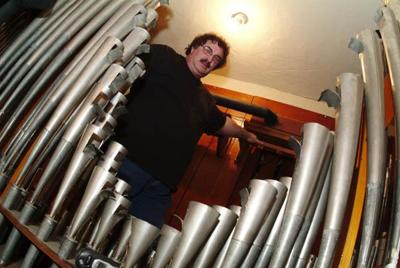
If Lubich had moved another switch, known as a stop, the combination of electricity and air could have caused a line of mallets to play a mounted xylophone or a glockenspiel. Or air could be blown into a line of tuba pipes that look like a skyline of metal fireplaces or another set of tuba pipes that look like the barrels of a bunch of blunderbuss shotguns.
Also, the room contains a snare drum and a curtain of chimes.
Tom De Lay, owner of this Wurlitzer Style 200 Special Theater Pipe Organ and maintenance technician for the Golden State Theater, says that theater pipe organs were created to be instruments that synthesize the sounds of a full orchestra. Unlike a modern synthesizer, which imitates the sounds of instruments electronically, the theater pipe organ actually plays the percussion instruments and blows air into pipes that simulate orchestral instruments.
“There is nothing electronic, nothing digital,” De Lay says. “It is all the real thing.”
De Lay says there are almost 100 stops, including an English horn stop and a violin stop. “Each one represents a different tonal color,” he says.
Also, the instrument differs from a classical or church organ. Church organs just don’t offer the wide variety of sounds that a theater pipe organ can.
In addition to being an amazing instrument, this particular pipe organ has an interesting history. Built in 1928 at the Wurlitzer factory in North Tonawanda, New York, the pipe organ was shipped to San Francisco’s Parkside Theatre, where it was played to accompany the screenings of silent films.
In 1938, the organ was sold to the United Presbyterian Church in Salinas for $3,000. While inside the building, De Lay says the pipe organ got rained on. At one point, five gallons of water had to be emptied from the one of the instrument’s bass pipes.
In 1989, the United Presbyterian Church was donated a new pipe organ. When the old one came up for sale, De Lay purchased it. De Lay kept the instrument in storage until 1992, when he installed the pipe organ in the United Artists owned State Theater, which was sold in 2004 to Warren Dewey, who rechristened it the Golden State Theatre.
Under Dewey’s ownership, the pipe organ is being played more frequently before screenings of classic movies like Casablanca and Forbidden Planet. In addition to moviegoers, De Lay believes the increased usage is a positive development.
“I think it is great,” De Lay says. “The thing about a pipe organ is the more it is played, the better it is.”
Tonight, while Lubich plays songs like “It Happened in Monterey” and a set of Broadway numbers including “That’s Entertainment,” De Lay watches intently as he stands a couple rows from the stage. While the sound blasts from the pipe chambers—which look like two ornate, oversized stereo speakers—Lubich’s left leg looks like a content cat’s swishing tail as it moves quickly to press some of the instrument’s 32 foot pedals.
(The San Francisco-based Lubich is one of two pipe organists who regularly play at the Golden State Theatre. The other primary organist is former Pacific Grove resident Tom Hazleton, who currently lives down in San Diego.)
After about 45 minutes worth of music, Lubich starts playing “The Carousel Broke Down,” which is more commonly known as the Looney Tunes theme song. As the organ slowly sinks, a Looney Tunes short appears on the theater’s massive screen. After the organ falls out of the audience’s field of vision, Lubich silently slides off the stool in front of the pipe organ and disappears into a hole under the stage that was designed as a door for the orchestra pit.


(0) comments
Welcome to the discussion.
Log In
Keep it Clean. Please avoid obscene, vulgar, lewd, racist or sexually-oriented language.
PLEASE TURN OFF YOUR CAPS LOCK.
Don't Threaten. Threats of harming another person will not be tolerated.
Be Truthful. Don't knowingly lie about anyone or anything.
Be Nice. No racism, sexism or any sort of -ism that is degrading to another person.
Be Proactive. Use the 'Report' link on each comment to let us know of abusive posts.
Share with Us. We'd love to hear eyewitness accounts, the history behind an article.