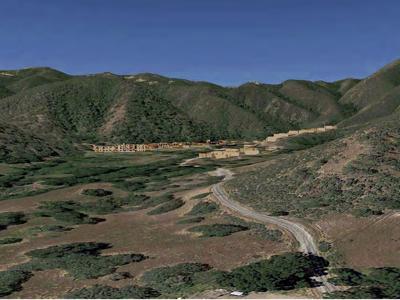

Set in a canyon at the eastern base of the Santa Lucia Mountains, the Paraiso Springs Resort calls for 73 timeshare units and a 103-room hotel. The project was approved by the Monterey County Planning Commission in October 2019.
The resort, long dormant, dates back to the 19th century. (Paraiso is Spanish for paradise.) It made a splash in the news in 2003 when the property’s owner, Thompson Holdings, LLC, tore down 12 cottages, nine that were deemed historic. It did not have a permit to do so, but was granted one after-the-fact.
But even with permits, the project isn’t expected to be built anytime soon: On June 29, it came back before the county Planning Commission, with the developer seeking to make amendments to the permit. Among them is to extend the required start date for construction – which was set to expire five years after the 2019 approval – another five years, meaning that construction doesn’t have to begin until 2029. Per a county report, the extension was being sought due to “pandemic-related uncertainty” and “supply chain issues related to timing and cost of construction.” The other amendment was to allow timeshare units to be reclassified as “residential,” which, under state law, allows an individual to own it outright. Attorney Tony Lombardo, representing the developer, said at the meeting that this is the new trend for high-end resorts, and that people want to own their units.
That said, individuals would not be allowed to occupy their unit more than 182.5 days annually (half the year). Lombardo said that most buyers would likely only stay about six weeks a year.
“It is not a residential community in any way, shape, or form,” Lombardo told planning commissioners.
The change in use classification also offers owners a potential way to generate income, as they can elect to allow the hotel to rent units out if they’re not occupying them.
The Planning Commission unanimously approved the amendments.
One issue got just a quick sentence from Lombardo in the course of the Planning Commission: the length of the dead-end road providing access to the project. Under both county and state code, the maximum length of dead-end roads is 5,280 feet; Paraiso Springs Road, which is located in a fire-prone region, is nearly double that at 10,032 feet, or 1.9 miles. It’s the only way in and out of the property.
The developer applied to Cal Fire for an exception to the rule last year. After being denied, they appealed to the county building department, which granted one.
Mike Novo, the county’s planner for the project, says that was in part because the road itself does not pass through a forested area – the road is bordered by grasses, which would presumably burn out quickly – and adds, “people can get out of there pretty easily and quickly.”
Novo adds that the amendments to the permit are to bring the project in line with current trends in the timeshare market.
“They’re going for a higher-end resort here,” he says.


(1) comment
Not much down that way, other than Arroyo Seco and the entrance to the River Road Wine Trail. Will people go to a Hotel/Time-Share just for a natural-spring hot tub in sufficient numbers?
Welcome to the discussion.
Log In
Keep it Clean. Please avoid obscene, vulgar, lewd, racist or sexually-oriented language.
PLEASE TURN OFF YOUR CAPS LOCK.
Don't Threaten. Threats of harming another person will not be tolerated.
Be Truthful. Don't knowingly lie about anyone or anything.
Be Nice. No racism, sexism or any sort of -ism that is degrading to another person.
Be Proactive. Use the 'Report' link on each comment to let us know of abusive posts.
Share with Us. We'd love to hear eyewitness accounts, the history behind an article.