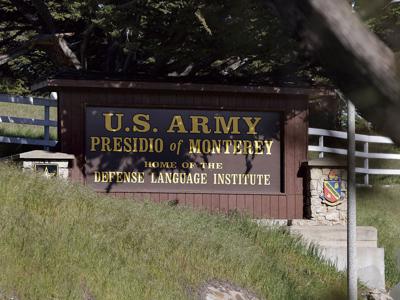

A year ago during September’s National Suicide Prevention Month, Jonathan Scott, the resiliency coordinator for the Defense Language Institute in Monterey, circulated the post’s Resiliency Newsletter to faculty featuring the month’s theme: “You are a light in somebody’s life.” Scott, an Army civilian employee, coordinated suicide prevention workshops for the month, including “Suicide Prevention for Families,” and “Value of Life Training.”
Less than three weeks after the awareness events concluded, Scott, 36, died by suicide on Oct. 17, according to a death certificate dated Feb. 5, 2024, issued at the conclusion of an investigation into his death by the Monterey County Coroner’s Office.
It was the fourth suicide of a DLI employee since 2022 – three educators died by suicide during that year alone. In the past 12 months there have been two deaths by suicide among students, according to a DLI report obtained by the Weekly.
“It’s really hard to have a closing statement other than the guy in charge of stopping suicides at DLI committed suicide. That’s horrible,” says Matt Snowden, former DLI faculty president, now living in Texas. Snowden says he interacted with Scott on resiliency efforts when he was still working at DLI.
“Resiliency” is the term the military uses for the psychological skill to deal with adversity and thrive in high-stress situations, and is used in conjunction with suicide prevention efforts. According to an article published on the U.S. Army website on May 1, DLI invested in a resiliency effort that began in April 2023 in response to “behavioral health challenges” at the institute. DLI chaplains created a “three-phase joint resiliency program” that was rolled out across the entire institute.
According to the article, the organizers presented at over 60 large sessions and more than 34 small group sessions, with a combined total of 750 hours of individual counseling. One chaplain was quoted as saying, “We think the program is working.”
In the past 12 months, there were over 50 instances of suicidal ideation among students, seven attempts and two completions, according to a report shared with staff on Sept. 13. Military and academic stress, along with family issues were cited as main contributors to some of the incidences.
“DLI is aggressively taking on the challenge of suicide prevention,” a spokesperson writes by email. He adds that year-round efforts seek to help students, servicemembers and civilian employees. Additional training is planned for supervisors on how to address mental health and suicide, as well as establishing trauma response teams for military and civilian workers.
The Department of Defense requires annual mandatory suicide prevention training for servicemembers, but within the last year announced that the training is optional for civilian employees.
In 2022, the most recent statistics available, the suicide rate among active duty members increased by 3 percent, according to the Department of Defense, although they noted it was below 2020’s average. Most suicides were among young enlisted men, the report said.


(9) comments
In reading the article and then the comments, I can see why there is exception taken to how it was written. It's no secret that Suicide is a contentious topic that has touched the lives of nearly all of us and therefore can be volatile. It needs to be handled with care, respect and compassion. I'm having a hard time finding any of that in this article and therefore, I tend to agree with both Amanda and David's comments.
Although Mary Jane's comment is most definitely accurate in that this topic absolutely needs coverage, she misses the entire point of both Amanda and David's feedback, neither of which claims that it shouldn't be covered, but rather it was covered poorly. Elizabeth seems to have had first hand experience with DLI and could likely be the most enlightened of the commenters.
When I first read the article, my husband commented on my furrowed brow. I had no idea that I was expressing my dismay non-verbally. I read it two more additional times and was still confused as to why Johathan was targeted after doing what sounded to be his very best to help people but became a victim himself of a potentially toxic situation. This article trivialized his contribution and was even spotlighted as ironic in Snowden's heartless comments. And, further to the point of Amanda and David, there were no other names mentioned even though there was plenty of opportunity to do so. The obvious question is, "why?". "A spokesperson" was cited by not named. Why just Johnathan? It feels deliberate. If you are going to name names, be consistent otherwise, you will be accused of putting someone on blast, someone who was a victim himself. Agreeing with Elizabeth, David and Amanda, I pray that his family doesn't see this damning article, especially this close to the anniversary of his passing. This article had tremendous potential but became an absolute train wreck. I hope this feedback is not ignored but rather learned from and I hope there is accountability taken, which is often nonexistent in the media. Mr. Scott's family deserves an apology. Period. Please do better.
I am somewhat hesitant to weigh in on this because I have no professional expertise on suicide prevention though I worked closely with someone closely who later took his own life and have known others who have left the world that way. Given the feedback this piece has elicited here goes:
An Army civilian employee [at DLI], who committed suicide, formerly coordinated suicide prevention workshops including “Suicide Prevention for Families,” and “Value of Life Training.” It is emphasized that “You are a light in somebody’s life.”
In my opinion this is not a good approach. Family can represent pressure on someone depressed/suicidal. The student who wants to make their parents’ proud but is flunking. The civilian who is losing their job and has dependents to support. They can come to feel the world, including their loved ones, is better off without them.
What you need is someone to say, “You are important to us.” This is what I got from one of my doctors on my cancer journey. I certainly didn’t get anything like that as a DLI civilian employee.
Instead, a former supervisor called me to discuss my termination. She focused her attention of answering emails not me and suggested I just rent out my house and return to my former life. I had family support and that made all the difference in a situation where I was told, “Don’t let the door hit you on the way out.”
I'm very confused with the author's intention of this article. The fact that there is a known and identified issue within a local institute that is creating a toxic environment for staff and students to the point of increased suicidal ideation, attempts and sadly deaths should be a call to arms for the entire community to work towards a healthier solution. It should prompt accountability through the eyes of empathy and compassion. What is the rationale or agenda in including only one person's name in the article, upon the anniversary of their death none the less. Is Mr. Snowden truly that tone deaf with the callousness of his comment regarding Jonathan? Is the author not applying their own professional filters on how that comment could be perceived and received, by Jonathan's family and friends, colleagues and students whom he provided support and resources to during his tenure at the school? If this was to honor a man who embraced Monterey will his heart and his soul, and who believed that human life is meaningful and individuals deserve to feel valued and respected, than this is insulting, and exactly part of the entire problem. His legacy should be inclusive of his entire life The tiniest effort in researching the mental state of individuals struggling with severe depression and suicidal ideation would show that inaccurate feelings of guilt, shame, embarrassment, feelings of being less than, and being a failure are typical, and yet the author chose to point the finger towards 1 individual vs the entire culture and organization. There's no real discussion of the current efforts, and unfortunately, the chaplain's quote is also clearly not reflective of the reality and severity of the situation. So again, I'm left not understanding the true intent of this article, that appears to turn a light on a terrible situation, that impacts so many, casually point fingers at one individual, share zero efforts towards creating a healthier environment, and then as an afterthought throws in the suicide hotline number.
I'm confused at the intent of this story, and disappointed with the approach to a topic that touches and impacts so many individuals directly and indirectly, as indicated in your own quoted stats. If the concern is for the lives of human beings in our community than why not focus on what is currently being done to support them through the campus and community. Suicide unfortunately can be fraught with judgement and cultural mores and choosing to name one victim despite indicating several others without calling out there names seems potentially hurtful to his family, loved ones and personal legacy.
Why not have used that information to further research what is creating such a clearly toxic environment for these staff and students. Instead it feels like an admonishment of Jonathan and the meaningful work he committed t, and for this reader, that came across with zero empathy. or human compassion.
The quote from Mr Snowden seems wildly callous and unwarranted. Let's stop blaming individuals for unhealthy environments and hold the entire system accountable. He too would have been part of the leadership that created the need for resiliency, how about a quote showing accountability? And speaking of quotes, the chaplain indicating things are working, clearly isn't in touch with the realities of their own reported statistics. It's clear something is broken and desperately needs to be addressed and quickly. Because too many lives have been lost and too many families and friends have grieved and mourned.
Gratitude for the work Jonathan did with passion and dedication and may his family find comfort in knowing he made an impact and a difference in his community. He was loved, and will be remembered with dignity and respect-despite this publishing.
Find the joy,
Amanda
I've read this article over and over and I'm just flabbergasted as to how this passes as journalism. I'm failing to see the point or call to action from this insensitive frivolous drivel. The obvious question that those in my circle are asking is; why spotlight Johnathan and no one else? Did that somehow enhance the potency of the article? Was it even relevant? Why why why? Did you get the blessing from his family to use his name and the circumstances surrounding his passing? Not thinking is not an excuse. When someone passes, they are not able to speak for themselves and their legacy is vulnerable and easily tainted. Congratulations, now when you google Johnathan Scott, guess what pops up instead of all the exceptional work he did in saving the lives of quite possibly hundreds of people. While it may not violate any laws, it certainly falls short of being empathic, ironically, what most would assume was the undertone of the article. And while this article from start to finish appears to be a major departure from what responsible journalism would dictate, I am hesitant to put Snowden on blast for his callous comment giving him the benefit of the doubt that perhaps he didn't actually say what was printed. Either way, it was in incredibly poor taste to print it regardless of the accuracy of the offensive "quote". You can search my history of making any comments on any platform, I simply don't. It takes a lot to move me to open my laptop and spend my valuable time. This article clearly stirred me enough to do so. Shame on Pam Marino and shame on any outlet that distributed it. Disgusting. This should be redacted, removed and there should be a public apology to Jonathan's family, his friends and all of those he assisted in their moments of need. Exposing this tragedy and outing Johnathan could have effectively triggered someone. Was that the intent? Again, it's hard to arrive at the true intention of this disastrous piece of trash. At the very least, Ms. Marino should be reprimanded. - David Hahklotubbe
I respectfully disagree. The topic has significance for the community and merits coverage.
Gratitude for your input. I think we are having two different conversations. Not once did I even insinuate that the topic is without merit. Quite the contrary, it needs to be screamed from the mountain tops. But it needs to be done with empathy and responsibility, what I took exception with was not the topic, but how it was mishandled. Again, thank you for your expression. I see that the latest person to give feedback, Noreen, seems to "get it". Thank you.
This comment strikes me as an attempt at censorship through shaming. In the view of David Hahklotubbe, Pam Marino, who covers DLI for this paper, should not have not have written about the suicide death of Jonathan Scott, DLI’s resilience coordinator, since it would tarnish his legacy and hurt his family.
The family has the right to omit cause of death from an obituary but whether they have the power to prevent an autopsy depends on state laws. An autopsy was conducted, and Ms. Marino used publicly available information as the basis for her story.
Scott’s death nearly a year ago is certainly a tragedy but I can also see DLI has an incentive to keep it quiet. It begs the question of whether their program is effective is the person leading it commits suicide? Very sad outcome.
I appreciate your feedback, thank you Elizabeth. I'm not sure how you came away with a message of intent toward censorship from my post. I've read my submission over and over and don't see it. But, ok. Two of the others to submit feedback, Amanda and Noreen, saw what I saw, and agree which is validating. To be crystal clear, my position is that this topic should be covered, but there should be more care taken in the delivery of the message. And, that message is still unclear even after reading the article. Is it a call to action for suicide prevention? Is it a slander against DLI? Is it a fact-based story telling focusing on the irony of the death by suicide of the person responsible for preventing it? There's no clear message that I can see, and by the looks of the recent feedback, I'm not alone. Perhaps my frame of reference is to blame as a Death Doula and Gerontologist for 25 years, I am very much focused on the dignity of dying and how that is a very private and personal process. No one should have the right to exploit cause of death. And no one should take the liberty to tarnish the legacy of an otherwise soulful and caring individual. This is less of a discussion about technicalities in autopsy reports being public and more a focus on ethics. I appreciate your feedback and how it stimulated me to be more precise in my clarifications.
Welcome to the discussion.
Log In
Keep it Clean. Please avoid obscene, vulgar, lewd, racist or sexually-oriented language.
PLEASE TURN OFF YOUR CAPS LOCK.
Don't Threaten. Threats of harming another person will not be tolerated.
Be Truthful. Don't knowingly lie about anyone or anything.
Be Nice. No racism, sexism or any sort of -ism that is degrading to another person.
Be Proactive. Use the 'Report' link on each comment to let us know of abusive posts.
Share with Us. We'd love to hear eyewitness accounts, the history behind an article.