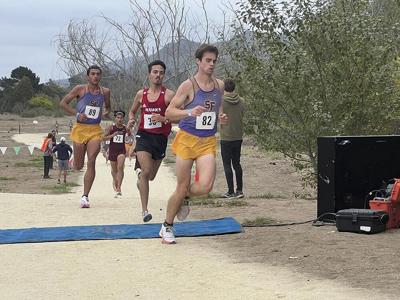

The controversy over the cross-country track at Palo Corona Regional Park does not appear to be going away anytime soon.
Over the past few months, various state agencies, which funded most of the $10 million-plus in grants for the Monterey Peninsula Regional Park District to acquire 185 acres of the former Rancho Cañada golf course property, have expressed major concerns that both laws and agreements were violated when the course was hastily constructed this spring. The U.S. Fish and Wildlife Service, in a July 25 letter, also sounded an alarm.
Construction of the 2.12-mile course, completed in May, was funded by more than $300,000 from the Big Sur Marathon Foundation for the laudable goal of giving local youth a beautiful place to race.
But speed – so critical in a race – is not typically the pace at which projects are planned and constructed in an environmentally sensitive area, one home to both threatened species and protected riparian habitat.
According to the park district’s public records, the State Coastal Conservancy, one of the grant-funding agencies for the Rancho Cañada acquisition, first learned of the track in February, and shared its concerns with the Park District. After subsequent communications, it was agreed the track would be moved entirely north of the river to avoid areas being excavated for a floodplain restoration project, which the Conservancy was overseeing.
In May, the Conservancy learned the track had been constructed – indeed north of the river – but within a designated 1,000-foot wide wildlife corridor in the grant agreement that allowed the park district to acquire the property, and which was also where the soils from the excavation were to be relocated.
In a Sept. 14 letter to the park district, SCC Executive Officer Amy Hutzel wrote she was “concerned” construction of the track “took place without obtaining required regulatory approvals, without compliance with mitigation measures for trail construction, and in a manner that appears to have adversely impacted riparian vegetation, heritage trees, and red-legged frog habitat.”
Hutzel’s letter goes on to add that “in light of the purposes for the Conservancy-granted funds to the Park District to acquire the property, I am concerned about the [district’s] decision to carry out this significant construction project without greater coordination with the Conservancy.”
In her letter, Hutzel refers to a June 14 California Department of Fish and Wildlife notice of violation, which expressed concerns over potential harm to the protected riparian habitat and “recommends restoration of the site to replace habitat resources and remove deleterious materials” like the decomposed granite used to construct the track. It also refers to the July USFWS letter highlighting concerns that the district may have violated the Endangered Species Act.
In conclusion, Hutzel wrote SCC staff would like to meet with the district and staff from the state Wildlife Conservation Board and CDFW – both agencies helped fund the acquisition – as soon as possible to work “on a resolution of our concerns.”
Hutzel tells the Weekly that meeting is scheduled for Sept. 29. MPRPD General Manager Rafael Payan did not respond to requests for comment.


(0) comments
Welcome to the discussion.
Log In
Keep it Clean. Please avoid obscene, vulgar, lewd, racist or sexually-oriented language.
PLEASE TURN OFF YOUR CAPS LOCK.
Don't Threaten. Threats of harming another person will not be tolerated.
Be Truthful. Don't knowingly lie about anyone or anything.
Be Nice. No racism, sexism or any sort of -ism that is degrading to another person.
Be Proactive. Use the 'Report' link on each comment to let us know of abusive posts.
Share with Us. We'd love to hear eyewitness accounts, the history behind an article.