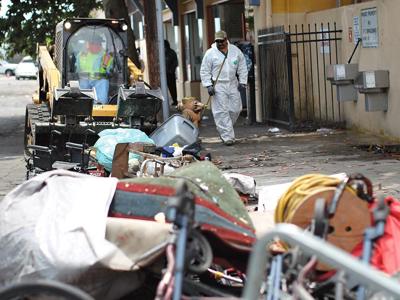

Until recently, the County of Monterey took a fragmented approach to homeless encampment cleanups in unincorporated areas. Sometimes Public Works responded, sometimes the Sheriff’s Office. Their actions were generally compassionate, says Director of Homeless Services Roxanne Wilson. She thought it was time to put it in writing.
“The spirit of compassion has always been there for the County of Monterey,” she says. “I found it was important to memorialize it in writing, not just for us but for the unsheltered community.”
On Jan. 28 the Board of Supervisors voted 5-0 on a new policy that runs all encampment cleanups through Wilson’s office, as well as provides guidelines on how to conduct them. It was modeled after a policy adopted by Gov. Gavin Newsom last year outlining how to approach encampment cleanups on state-owned properties.
The policy includes creating an Encampment Assessment Team when a location is identified, made up of county agencies and community nonprofit partners relevant to the needs of a specific location.
Outreach to encampment residents would be the first step, unless in an emergency, as well as identifying available shelter beds. The initial goal would be to encourage people to voluntarily leave. If that’s not possible, there would be 72 hours’ notice. The county is offering storage of personal belongings for up to 90 days.
“There are ways and strategies we can employ whenever possible to get folks to move on their own, or provide ways to do their own cleanup,” Wilson says.
In her presentation to the board, she said the policy acknowledges cleanups are a “very complex situation. We do not have enough housing, we do not have enough shelter beds but what we do have is compassion.”
She said the policy is embedded with practices that include housing first – a state law that places an importance on providing housing for those who are unsheltered – as well as trauma-informed care and harm-reduction strategies.
“If we don’t provide an alternative place to go we will see them return in the future,” she says.
The board also approved a memorandum of understanding with Access Support Network – a nonprofit that provides naloxone, needle collection and distribution – for one year to assess and track encampment occupants’ prescription medication needs. ASN will also do outreach ahead of cleanups and help those who lose medications get new prescriptions.
Currently there are three large encampments in unincorporated areas in Pajaro, Soledad and outside of Salinas. A fourth in King City was moved to a local hotel after a fire in 2022 at the encampment. The move was facilitated with a $6.4 million state grant. Another grant of $4.7 million went toward Soledad.
A project to provide tiny homes to Pajaro occupants in Watsonville using an $8 million grant is on hold, pending an appeal by neighbors.



(0) comments
Welcome to the discussion.
Log In
Keep it Clean. Please avoid obscene, vulgar, lewd, racist or sexually-oriented language.
PLEASE TURN OFF YOUR CAPS LOCK.
Don't Threaten. Threats of harming another person will not be tolerated.
Be Truthful. Don't knowingly lie about anyone or anything.
Be Nice. No racism, sexism or any sort of -ism that is degrading to another person.
Be Proactive. Use the 'Report' link on each comment to let us know of abusive posts.
Share with Us. We'd love to hear eyewitness accounts, the history behind an article.