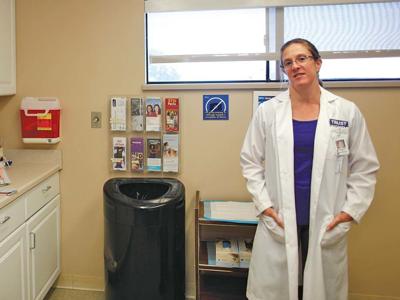

Two decades ago, when Jessica Dieseldorff started her work as a nurse practitioner with Planned Parenthood Mar Monte, it was rare to see patients with syphilis. The disease was considered by many to be an “old-fashioned” disease, she says, something artists and musicians of long ago suffered from. Now the associate director of advanced practice clinicians says she and her staff at the Seaside and Watsonville clinics regularly see men and women with syphilis as well as chlamydia and gonorrhea.
Sexually transmitted diseases have been on the rise in Monterey County since 2010 and in California since 2013, according to the Monterey County Health Department. Gonorrhea rates were four times higher among county residents in 2018 than in 2009, rising from 23 cases per 100,000 residents to 98. Syphilis rates in 2018 were over 20 times the rate in 2009. The trend has public health experts alarmed, especially since many diseases – as well as their spread – are preventable. Caught early, many STDs are curable and all are treatable while the consequences of doing nothing can be deadly.
One example that has experts worried is infants born with syphilis – five have been born in the county since 2015 and nearly 1,000 were born in California in 2017. Monterey County epidemiologist Kristy Michie says pregnant women who go untreated can lead to damage to the developing fetus’ bones, brain and eyes and can even lead to stillbirths and death. “It’s a very severe disease in newborns,” Michie says. Antibiotic treatment during pregnancy can prevent complications.
Despite advances in treatment for diseases like HIV and hepatitis C, health officials say they feel as if the state is losing ground. Over 5,000 Californians are newly diagnosed with HIV annually, more than any other state, according to a statewide coalition of health and social service organizations called End the Epidemics.
Dieseldorff says part of the problem is stigma and shame around sexual practices and STDs, and calls for more screenings and discussion. Others, like Craig Pulsipher of ALPA Health in Los Angeles, one of the organizations behind End the Epidemics, say it will take money and political will to successfully combat the state’s syndemic – the interrelated epidemics of STDs, HIV and hepatitis C.
“The state’s public health efforts to address them have been pretty poor for the last decade or so,” he says. In 2009 the state cut $33 million from the budget for HIV prevention and only about $7.5 million has been restored. “Given the scope, those are very small dollars to tackle the problem at hand,” Pulsipher adds.
In March, more than 130 organizations signed a statement calling on Gov. Gavin Newsom to convene a statewide task force to address the syndemic, similar to what Gov. Andrew Cuomo of New York did in 2015 to end the AIDS epidemic there. At least $20 million was committed by state legislators and new infections have decreased by 20 percent since then, Pulsipher says.
End the Epidemics is asking Newsom for $2 million in the 2019-20 budget to cover task force costs. On April 30, advocates are planning a rally in Sacramento calling for a total of $60 million more added to the budget – $20 million each for prevention, testing and treatment of HIV, hepatitis and other STDs.



(0) comments
Welcome to the discussion.
Log In
Keep it Clean. Please avoid obscene, vulgar, lewd, racist or sexually-oriented language.
PLEASE TURN OFF YOUR CAPS LOCK.
Don't Threaten. Threats of harming another person will not be tolerated.
Be Truthful. Don't knowingly lie about anyone or anything.
Be Nice. No racism, sexism or any sort of -ism that is degrading to another person.
Be Proactive. Use the 'Report' link on each comment to let us know of abusive posts.
Share with Us. We'd love to hear eyewitness accounts, the history behind an article.