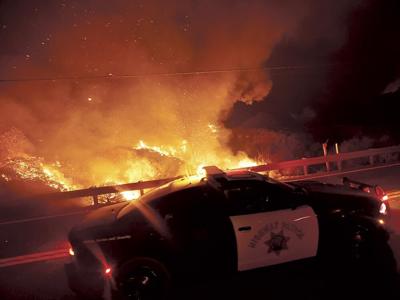

By 9pm on Friday night, Jan. 21, a vague, wine-colored glow was visible from as far north as Santa Cruz. Wildfire reports in Big Sur had been surfacing for almost two hours, but with poor cell phone and internet service, few pictures and videos were yet available. Not even the police officers called to shut down the highway at Carmel knew the specifics – they were certain only of their orders: let no southbound drivers through.
That glow and a rough outline of smoke were all the eye could see heading down Highway 1 until around a turnout at Rocky Point Restaurant, where a handful of cars able to negotiate their way through the first police barricade were scattered. Sierra Severson, born, raised and living with her family in the Palo Colorado Canyon region of Big Sur, expected to be home already after a night working up north. Instead, she stood silently, and helplessly watched as wildfire flames rapidly engulfed the sprawling ridges ahead.
“My sister was up at the house, I don’t know if she has evacuated,” Severson says. “My parents are out of town, so it’s kind of extra scary because they told me all the things I should get from the house in case anything ever happens, but now I can’t even get there.”
Severson says the glowing ridges are not entirely unfamiliar, except for one thing.
“For January, it’s kind of the last thing you would expect,” Severson says. “It’s shocking because it’s just not the season.”
The Big Sur blaze, named the Colorado Fire, sparked around 5:10pm on Friday, Jan. 21, behind the Mid Coast Fire Station on Palo Colorado Road. State fire agency Cal Fire reported the fire began after hot embers from a pile-burning operation blew into nearby vegetation. Helped by winds that reportedly reached near 50mph on some ridges, the flames spread rapidly, scorching land near Bixby Bridge and at one point burning on both sides of Highway 1 at Rocky Creek Bridge. Initial reports estimated a size of 1,500 acres but improved mapping showed the Colorado Fire burned 700 acres.
For many, the Colorado Fire has effectively eliminated the notion of a wildfire “season,” which has been a growing conversation across California as conditions have become drier and wildfires more common. Matt Harris, chief of the volunteer-run Big Sur Fire, says he was not completely surprised. He compares it to the 917-acre Pfeiffer Fire back in December 2013. Similarly, that year saw early-season rain followed by an extended period of dryness and then high winds that helped carry the fire.
The Pfeiffer Fire, which destroyed dozens of homes, was started by an electrical issue. The specifics around the pile burn that sparked the Colorado Fire, which destroyed one home after threatening dozens, remain under investigation.
According to a National Weather Service report from the weekend, the fuels chart – an assessment of vegetation that becomes “fuel” when a fire is burning – was normal, “which normally means things don’t actively burn in January.” However, the windy weather, combined with dark night skies and precipitous terrain made for a precarious situation on Friday evening and stalled immediate response to the blaze which, at one point, was rapidly spreading north before shifting wind diverted its path.
Progress in containing the Colorado Fire began on Saturday, Jan. 22, as daybreak brought humidity, calmer winds, and daylight, which allowed for aircraft to attack the fire with tens of thousands of gallons of water collected from the ocean and Rocky Creek, as well as bright red fire retardant. Matthew Wright, a member of Cal Fire’s aviation team out of Hollister, calls it “pretty lucky” to have the ocean so close, which allows for “quick trips and high production.”
Among the shuffling of dozens of firetrucks and the hundreds of state firefighters called to arms from as far as Ventura County, Mid Coast Fire Brigade Chief Cheryl Goetz was parked in a marked vehicle facing her volunteer-run station, just below where the fire began. Under the roar of helicopters and planes battling the fire from the sky, Goetz, a 25-year veteran of the brigade, explains that real progress cannot begin until “we can get boots on the ground.” The boots on the ground build fire breaks – a critical containment strategy requiring firefighters to hike into the immediate outskirts of the blaze with hatchets and chainsaws to clear a perimeter of vegetation and fire fuel.
Goetz says they needed to be cautious about sending in teams, as fire containment along Big Sur’s steep ridges has a deadly history. Goetz, exhausted and fighting back tears, says local volunteer squads like hers are not here because of a job assignment; they are here out of love and deep concern for their community.
“It’s not someone else’s home that is going to burn; it’s our home, it’s our friend’s, our family’s, our neighbor’s,” Goetz says. “The community needs to know how hard we are working. We’re going to get there.”
As of Wednesday, Jan. 26, Cal Fire reported the Colorado Fire remained at 700 acres and was 55-percent contained. Evacuation orders for about 75 homes remained in effect as of the Weekly’s deadline, and Highway 1 remained closed at Granite Canyon Bridge from the north and Andrew Molera State Park from the south.



(0) comments
Welcome to the discussion.
Log In
Keep it Clean. Please avoid obscene, vulgar, lewd, racist or sexually-oriented language.
PLEASE TURN OFF YOUR CAPS LOCK.
Don't Threaten. Threats of harming another person will not be tolerated.
Be Truthful. Don't knowingly lie about anyone or anything.
Be Nice. No racism, sexism or any sort of -ism that is degrading to another person.
Be Proactive. Use the 'Report' link on each comment to let us know of abusive posts.
Share with Us. We'd love to hear eyewitness accounts, the history behind an article.