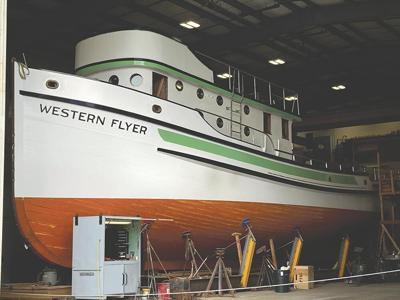

In March 1940, a 77-foot long purse seiner named Western Flyer motored out of Monterey Harbor with six men and one woman on board. Along with the captain and three crewmen, they included John Steinbeck, an already famous writer, his wife Carol, and Steinbeck's good friend Ed Ricketts, a pioneering marine biologist. The boat traveled south, toward the Sea of Cortez, in Mexico, and their journey would become the subject of one of Steinbeck’s most acclaimed books.
The Western Flyer went on to become a working fishing vessel for more than a half century before being sold to developer Gary Kehoe, who envisioned displaying part of it along a wall at a planned restaurant in Salinas. Then the boat sank – twice – in 2012.
Kehoe sold the boat for $1 million in 2015 to John Gregg, an engineer and entrepreneur who was inspired by reading Steinbeck’s book when he was 10-years old in 1970. Gregg had a higher use for the Flyer in mind: turn it into a floating marine biology classroom and working research vessel. With that in mind, he launched a nonprofit—Western Flyer Foundation—with the mission “to stir curiosity by connecting art and science in the spirit of John Steinbeck, Ed Ricketts, and their journey.”
For the past six-plus years, the boat has undergone restoration in Port Townsend, Washington. Chris Chase, the foundation’s project director, calls it “the epicenter of wood boat construction in North America.” The bandsaw used to build the boat in 1937 is the same one used for its restoration. “The exact same bandsaw cut all the wood twice,” he says.
The boat is being restored, Chase says, to the same condition it was in when it left Monterey in March 1940. He says the Flyer is expected to finally return to Monterey this October, where it will anchor for a couple weeks before heading up to Moss Landing for the winter. It will then be outfitted with modern mechanical systems for marine science research.
The long term vision for the Flyer is for it to berth in Monterey, and sometimes at Moss Landing and maybe Santa Cruz. It will sometimes serve as a tourist attraction but often a floating classroom. The foundation sent an application to the office of Rep. Jimmy Panetta, D-Carmel Valley, on April 11, seeking $1.75 million to retrofit the Coast Guard pier in Monterey – which is owned by the city – to build a permanent berth for the boat. The proposal includes creating plans for an on-pier classroom in place of the derelict building that stands there now.
Emily Gottlieb, the foundation’s education director, says only a handful of students can fit on the boat at one time. The vision is to take them out on the bay to conduct research with the most modern tools, while the other students learn in the classroom about those tools and marine life. It will do the same for some months all along the West Coast.
Monterey City Manager Hans Uslar says the city has not yet dedicated any funds to the pier restoration, but that it is a welcoming partner to the project and could do so in the future. According to Panetta’s office the funding application – under newly revived budget earmarks – won’t come up for approval until about a year from now.
That means the Flyer’s home in Monterey will be temporary for the indefinite future, until funding comes through for the pier’s restoration.
--
Correction (4/25/22): The original version of this story incorrectly stated the number of the men on the boat (it was six, not five) and also didn't mention that Steinbeck's wife at the time, Carol, was also on board.


(1) comment
This is an interesting development. Should make for lots of fun, and new jobs!
Welcome to the discussion.
Log In
Keep it Clean. Please avoid obscene, vulgar, lewd, racist or sexually-oriented language.
PLEASE TURN OFF YOUR CAPS LOCK.
Don't Threaten. Threats of harming another person will not be tolerated.
Be Truthful. Don't knowingly lie about anyone or anything.
Be Nice. No racism, sexism or any sort of -ism that is degrading to another person.
Be Proactive. Use the 'Report' link on each comment to let us know of abusive posts.
Share with Us. We'd love to hear eyewitness accounts, the history behind an article.