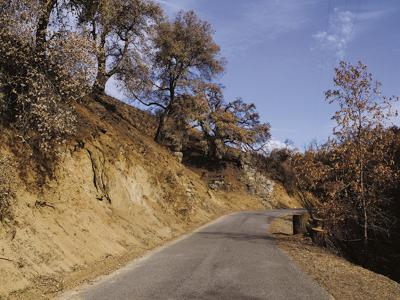

As federal officials assessed the impacts of the Tassajara Fire, which burned nearly 1,100 acres in the Cachagua area in September, they confirmed what many residents feared: The fire burned extremely hot, altering the nature of the soil.
“It’s bad,” says Bobette Parsons, a soil conservationist at the Salinas office of Natural Resources Conservation Service. “There were parts that were hot enough that I would be surprised if there was still a seed bank.”
Where the fire burned hottest, the soil has become hydrophobic, meaning that it repels water. That increases the potential for erosion and prevents whatever seeds that remain in the soil from sprouting.
Increasing erosion potential further is the steep topography of the Cachagua landscape, and a winter projected to bring well above average rainfall. According to data provided by NRCS, 71 percent of the burn scar is in “very steep” terrain – meaning that its slope is greater than 50 percent – and the erosion hazard in nearly 40 percent of the burn scar is rated “very severe.”
In early October, Parsons conducted assessments of six properties affected by the fire, evaluating whether or not there is “imminent danger to life and property.” She found that no structures were in danger, meaning none of the property owners are eligible for federal Emergency Watershed Protection Program funds that would allow NRCS to reseed the property and put in erosion controls.
Parsons saw several private roads likely to give way in the coming winter, but says they are excluded from the EWP funding criteria. The same goes for parts of Cachagua Road and Tassajara Road that might get covered by mudslides.
The county has overseen the removal of hazardous waste from burned properties, and the county is expediting permits and waiving fees for property owners looking to rebuild. But beyond that, there is little the county can do except wait.
Bob Murdoch, director of Monterey County Public Works, says his department is aware of the high likelihood of erosion, and that a team of contractors is lined up to assist if needed. But the county won’t undertake reseeding because it would constitute a use of public money to reseed private land.
Parsons is available to offer advice to property owners. But she says the steep terrain in the area means that much of the reseeding would have to be done by air, which is costly.
“A lot of people say, ‘I just lost everything, I don’t have the money,’” Parsons says. “It’s going to be very hard.”





(0) comments
Welcome to the discussion.
Log In
Keep it Clean. Please avoid obscene, vulgar, lewd, racist or sexually-oriented language.
PLEASE TURN OFF YOUR CAPS LOCK.
Don't Threaten. Threats of harming another person will not be tolerated.
Be Truthful. Don't knowingly lie about anyone or anything.
Be Nice. No racism, sexism or any sort of -ism that is degrading to another person.
Be Proactive. Use the 'Report' link on each comment to let us know of abusive posts.
Share with Us. We'd love to hear eyewitness accounts, the history behind an article.