Not all bureaucrats spend all day behind a desk. At the California Department of Consumer Affairs’ burn lab in Sacramento, they take torches to furniture or electronics and count how many seconds pass before the household goods go up in smoke.
Under direction from Gov. Jerry Brown, the Bureau of Electronic and Appliance Repair, Home Furnishings and Thermal Insulation is now rewriting the state’s 1975 fire resistance protocol. That’s thanks in part to years of study on Salinas women and children whose exposure to flame retardants has been linked to low birth weights and disrupted thyroid function during pregnancy.
“It turns out that what we’re studying here affects the state of California,” says Kimberly Parra, coordinator of the Center for the Health Assessment of Mothers and Children of Salinas.
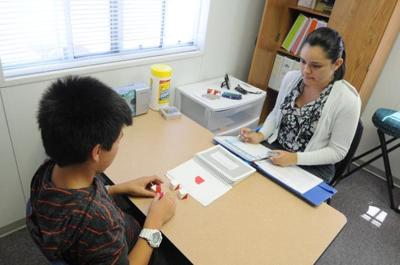
CHAMACOS, in partnership with Natividad Medical Center and Clinica de Salud del Valle de Salinas, is UC Berkeley School of Public Health’s local outpost for an ambitious, years-long study on environmental health.
The center has examined the effects of pesticides, household cleaners and other chemicals on mothers and their 12-year-old children, beginning more than a decade ago by collecting prenatal data. (Next up: a short-term study on Hispanic teenage girls and cosmetics.)
Mexican-American children in the CHAMACOS study had flame retardant chemicals in their blood at levels seven times higher than a control group in Mexico. These persistent chemicals – polybrominated diphenyl ethers, or PBDEs – can migrate out of fire-proofed electronics, couches and other household goods, and settle in dust.
CHAMACOS researcher Asa Bradman lists some household fixes: swapping carpeting for hard-surface flooring, cleaning frequently and removing dust. “These things actually make a difference in exposure,” he says, “but there’s a larger policy environment that results in the use of PDBEs, so it’s hard to avoid.”
Regulators are now transforming data from Bradman’s linear regression models into law. The Department of Consumer Affairs held two public workshops this week on revamped testing procedures that will control for smoldering, not open flames.
Consumer Affairs spokesman Russ Heimerich says the new, less stringent standards shouldn’t reduce fire safety.
“One of the things we weren’t doing 40 years ago was requiring smoke alarms,” he says. “The whole idea of a flammability standard is not to prevent ignition, because you can’t. The idea is to make a fire more survivable; what it all comes down to is time to get out of the burning area.”
The governor’s directive is widely viewed as a quicker solution than a heavily lobbied Legislature writing new laws. An industry group, the American Chemistry Council, spent $53,000 lobbying in California in 2011, including a $1,500 gift to Assemblyman Luis Alejo, D-Watsonville.
ACC spokesman Bryan Goodman deferred questions to individual manufacturing companies.
At least one study participant is pleasantly surprised lawmakers took note of the CHAMACOS research. Maria Moreno, 46, enrolled in the study two years ago with the youngest of her four children, a then-9-year-old son.
She takes time out of her winter job as a cook and summer job as a farmworker to continue giving blood, hair and urine samples, mostly because she’s fascinated by science.
“I wasn’t anticipating [the governor] would do anything,” she says. “But now I feel better about the well-being of my son.”


(0) comments
Welcome to the discussion.
Log In
Keep it Clean. Please avoid obscene, vulgar, lewd, racist or sexually-oriented language.
PLEASE TURN OFF YOUR CAPS LOCK.
Don't Threaten. Threats of harming another person will not be tolerated.
Be Truthful. Don't knowingly lie about anyone or anything.
Be Nice. No racism, sexism or any sort of -ism that is degrading to another person.
Be Proactive. Use the 'Report' link on each comment to let us know of abusive posts.
Share with Us. We'd love to hear eyewitness accounts, the history behind an article.