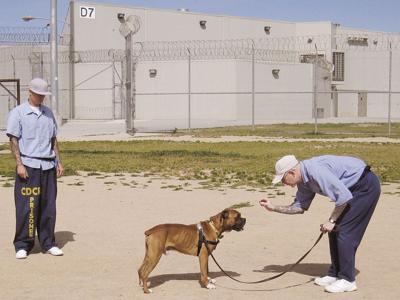

Salinas Valley State Prison is no longer a maximum-security facility exclusively for criminals. It is now a place for rowdy dogs to straighten up as well.
These dogs are not exactly serving time for being unruly, but rather, they are there to immerse in an intensive eight-week foster program. The boot camp of sorts will get them trained in hopes they will shed bad behavioral issues at the prison and come back ready for the adoption floor at the SPCA for Monterey County.
The dog coaches during this program will be inmates. Each dog will be housed with a pair of inmates inside their cells, and will be under their supervision 24 hours a day, seven days a week. Throughout the day there will be multiple training lessons outside the prison cell.
This new foster program has been in the works for three years. And in the past month, SPCA staff has been going to the prison three times a week to instruct inmates on how to train the animals. Among the goals are that the animals become housebroken, learn how to walk on a leash and show good doggy manners.
“This is something very innovative. We have never had a program like this.”
One reason for the delay to start the program is because this type of program is unprecedented at a maximum-security prison in California, says Matthew Atchley, associate warden at the correctional facility.
Not only did the curriculum have to be crafted – supervisors of the program had to make sure appropriate inmates were selected to participate.
“This is something very innovative. We have never had a program like this,” Atchley says. “So we are all working very hard to make sure it goes as planned.”
The four inmates that will participate in the pilot program, which starts the week of May 16, were selected out of a pool of inmates. Prison officials weeded out those with violence-related convictions, as well as those who had disciplinary strikes against them while in custody during the past year.
The dogs chosen for this program also had to go through a selection process.
“They are adolescent dogs, and the ones that are usually jumping at people – the wild children from the bunch,” says Amanda Mouisset, the behavior and training manager at the SPCA.
The dogs that were selected were a beagle named Rusty and a terrier mix named Brodie. For now, the program will only place two dogs, but the hope is that eventually five dogs will be assigned to the program every eight weeks by the end of the year.
Training lessons for inmates, pet food and other essential pet necessities are covered financially by the SPCA.
While the day-to-day care and training will benefit the animals, this program is also meant to help inmates. Participating in this program could potentially grant inmates an early parole, since the training is considered a full-time job and can be included in a reference to the parole board.
Atchley says the inmates are already excited to help the community, even if it happens while they’re still behind bars.
Upon graduation, the pups will receive a certificate for their training. Inmates will write their dogs a short biography, noting the skills and talents they learned during their time in prison, for their new families to read.
(Editor's note: An earlier version of this story stated the program was at Soledad State Prison. In fact, it is at Salinas Valley State Prison, also located in Soledad.)


(1) comment
Brodie doesn't look like a terrier mix. Boxer maybe? My dog went through the Take the Lead program at the SPCA with juvenile offenders, and the training went well.
Welcome to the discussion.
Log In
Keep it Clean. Please avoid obscene, vulgar, lewd, racist or sexually-oriented language.
PLEASE TURN OFF YOUR CAPS LOCK.
Don't Threaten. Threats of harming another person will not be tolerated.
Be Truthful. Don't knowingly lie about anyone or anything.
Be Nice. No racism, sexism or any sort of -ism that is degrading to another person.
Be Proactive. Use the 'Report' link on each comment to let us know of abusive posts.
Share with Us. We'd love to hear eyewitness accounts, the history behind an article.