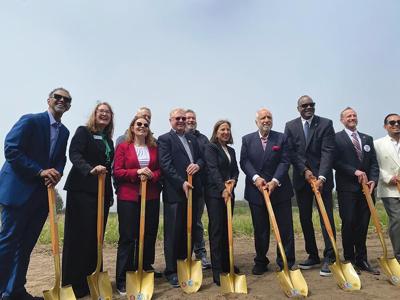

On Friday, April 11, when Danny Bakewell Jr. addressed the crowd gathered for the groundbreaking of the Campus Town project in Seaside, he effused a sense of relief that the project – more than a decade in the planning – was finally getting started.
The project is planned to have 842 for-sale homes, about 600 apartments, 100,000 square feet of retail and a hotel with up to 225 rooms. After a delay of about two years in order to deal with some contaminated soil, it finally had sign-off from regulators.
But in the days immediately following, contractors conducting a pre-grading survey identified the presence of Monterey spineflower, a protected species. For several weeks after that, there was nothing that could be done except wait for the plant to bloom, which reveals the distinctive features necessary to identify its sub-species.
Bakewell says that’s now happened, though he can’t recall what color the flowers were, just that the law requires the plant be replanted in a suitable location. The only setback, he says, has been time: Bakewell now expects grading to begin sometime after July 4.
It’s also meant that the city of Seaside hasn’t yet been able to sell any land to Bakewell’s company – part of their agreement is that the land must be ready to grade before any money changes hands. (Seaside City Manager Greg McDanel says the city’s sale price for the land to build the first part of Campus Town, Phase 1a, is $6 million. The first phase is located south of Lightfighter Drive between 1st Avenue and Gen. Jim Moore Boulevard.)
Once grading is completed, installation of underground utilities infrastructure can begin. Bakewell expects it will take at least a year before construction starts to go vertical. “At this point, we’re several millions of dollars invested in this project, and they say time is money,” Bakewell says. “As soon as we start selling homes, we can get caught up… Once we get started, we’re very hopeful we’ll not have any delays.”
The delay highlights the difficulty – and the cost – of developing on the former Fort Ord, where if there are not blighted structures or contaminated soil, there are likely protected species.
The challenges of developing on the former Fort Ord are also highlighted by a joint lawsuit that Center for Biological Diversity and Landwatch Monterey County filed against the City of Seaside in 2024 over the city’s 2040 general plan, and specifically, its plans for the future development of “Seaside East,” about 500 acres of maritime chaparral east of Gen. Jim Moore Boulevard.
In a brief the plaintiffs submitted in May, they argue that not only is the land ecologically sensitive, but also that there is no available water to develop it because of an existing legal settlement between Marina Coast Water District and Landwatch. The settlement caps residential units on the former Fort Ord at 6,160, and with Campus Town’s 1,485 units, plus what was already entitled before it, the number has reached at least 6,150. Yet Mayor Ian Oglesby has repeatedly said the plan has always been to put affordable housing at Seaside East.


(2) comments
The solution to the housing crisis is simple--kick out those who should not be here.
The blight of affordable housing has no end in sight. Monterey County will soon be a shadow of its former self. Traffic, trash, and noise all under the guise of "affordable housing."
Welcome to the discussion.
Log In
Keep it Clean. Please avoid obscene, vulgar, lewd, racist or sexually-oriented language.
PLEASE TURN OFF YOUR CAPS LOCK.
Don't Threaten. Threats of harming another person will not be tolerated.
Be Truthful. Don't knowingly lie about anyone or anything.
Be Nice. No racism, sexism or any sort of -ism that is degrading to another person.
Be Proactive. Use the 'Report' link on each comment to let us know of abusive posts.
Share with Us. We'd love to hear eyewitness accounts, the history behind an article.