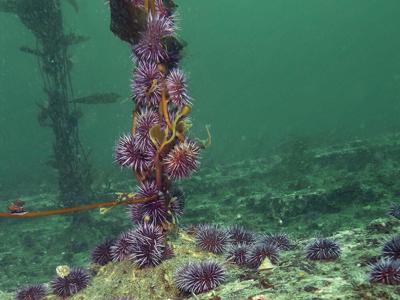

Keith Rootsaert has been diving in Monterey Bay since the 1980s. By the early 2010s, he began noticing the decimation of the bay’s giant kelp forests.
The culprit, according to a new study led by UC Santa Cruz graduate researcher Meredith McPherson, was a perfect storm of ocean warming events that kept the local giant kelp forests malnourished – giant kelp flourish in cold water – and a marine pandemic that effectively wiped out the sunflower sea star, a crucial predator to kelp-grazing sea urchins. The once thick mane of giant kelp forests surrounding the Monterey Peninsula and Central Coast today looks more thin and patchy.
Scientists say kelp forests harbor marine ecosystems, much like forests on land, and their deterioration could cascade into larger ecological consequences. Central to the ecosystem is the relationship between sea urchins and kelp. According to another study led by UC Santa Cruz graduate researcher Josh Smith, sea urchins typically camp out in crevices of rocks and reefs and eat kelp that inevitably falls, like leaves from a tree. The ocean warming events thinned out some forests and forced starving urchins to emerge from their rocks and openly graze on kelp.
According to data collected by Dan Abbott at the Reef Check Foundation, in 2013, there were 3.7 giant kelp stems vs. 0.4 purple urchins per square meter in the Monterey Bay. By 2019, Abbott reported 1.5 giant kelp stems vs. 103.2 purple urchins per square meter.
Patches of kelp forests throughout the bay are being replaced by urchin barrens. In an effort to replenish the forests, Rootsaert pushed for an amendment to the state’s fish and game rules to allow recreational divers to kill sea urchins at will. The California Fish and Game Commission rejected Rootsaert’s efforts in 2017 and 2019. When they said no a third time in early 2020, Rootsaert refused to back down. He organized hundreds of divers to write letters and fill the public comment portions of commission meetings with arguments for the amendment.
The pressure campaign worked. In December, the commission adopted a pilot version of the amendment. Starting April 1, recreational divers with a fishing license will be allowed to kill sea urchins at will; however, this will only be allowed within designated boundaries at Tanker’s Reef, off Del Monte Beach.
The impact of declaring open season on sea urchins is unknown and will be monitored over the course of three years, says James Ray, Kelp Restoration Coordinator with the California Department of Fish and Wildlife.
Rootsaert says the proper method of killing urchins is by “bashing them with a hammer.” He wants to keep the effort organized and ethical, and he will hold urchin-bashing classes through his organization, the Giant Kelp Restoration Project, starting in mid-April; 117 divers have signed up thus far.
“I’m not saying we’re going to hit a home run with this thing,” Rootsaert says. “But throw me the ball, I want a chance.”


(0) comments
Welcome to the discussion.
Log In
Keep it Clean. Please avoid obscene, vulgar, lewd, racist or sexually-oriented language.
PLEASE TURN OFF YOUR CAPS LOCK.
Don't Threaten. Threats of harming another person will not be tolerated.
Be Truthful. Don't knowingly lie about anyone or anything.
Be Nice. No racism, sexism or any sort of -ism that is degrading to another person.
Be Proactive. Use the 'Report' link on each comment to let us know of abusive posts.
Share with Us. We'd love to hear eyewitness accounts, the history behind an article.