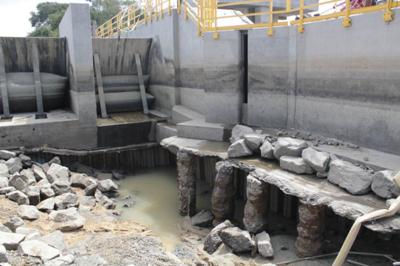

A fter only its second summer in operation, the Salinas River’s rubber dam needs emergency repairs due to erosion of the river bottom. The $14 million project promised to solve the seawater intrusion problem threatening Salinas Valley agriculture’s water supply.
Photo Gallery
Salinas River Rubber Dam

Looks at the ongoing repairs on the Salinas River rubber dam after erosion undermined the south bank of the river, creating a sinkhole.
Along the shore of the Salinas River, just downstream of the dam, is a sinkhole so deep the bottom is barely visible. The dangerous spot was cordoned off last week by crime scene tape (the Monterey County Water Resources Agency did not have less ominous caution tape available) as a team went to work draining the river to begin dam repairs.
“It is a true emergency for us,” says Brent Buche, assistant general manager for MCWRA. “We need to get it together before the winter flows.”
The MCWRA board on Aug. 22 unanimously approved $800,000 for repairs, awarding the contract to the Don Chapin Company.
The rubber dam, or Salinas River Diversion Facility, delivered 3,400 acre-feet of water to North County farmers this year. Part of the Castroville Seawater Intrusion Project, the facility diverts river water to 12,000 irrigated acres known as Zone 2C, whose fields are recognizable by their magenta pipes. The “purple line” irrigates those fields with a combination of recycled water, seasonal Salinas River water, and groundwater when the other two sources run short.
Though it will take up to 10 years for the rubber dam’s effects on groundwater levels and seawater intrusion to be quantified, project proponents say they’re satisfied with how the dam’s been working, despite the erosion problem.
It was the sinkhole that gave the first clues that something was amiss. As the river bottom material eroded, it sucked away supportive material below the fish ladder, a structure adjacent to the dam. From there, subsurface dirt and onshore rocks were also swept downstream, creating the onshore sinkhole, visible at first only as a depression.
Now that the river is drained and the damage surveyed, Buche confirms the structural integrity of the dam remains intact, though engineers are still investigating the damage. “Scour’s what caused it,” he says. “But why did that happen? Was it a miscalculation in the design?”
Nancy Isakson, president of the Salinas Valley Water Coalition, shares that concern. “It’s a disappointment and it’s a tremendous cost,” she says. “It makes you wonder, was something missed by the engineers in the construction process?”
It’s not the first time the design of the project has fallen under scrutiny. In 2002, more than a dozen Gonzales-area growers sued the county, saying the project would never delivered water to South County as promised, so they shouldn’t have to share the burden of paying for it. Monterey County Superior Court Judge Michael Fields ruled in their favor.
But even there, water doesn’t reach elevated Prunedale or Granite Ridge. A 2008 letter to County Supervisor Lou Calcagno from the Pajaro/Sunny Mesa Community Services District derides the rubber dam’s relationship to Prunedale as “voodoo hydrology.”
“Water, even groundwater, does not run uphill,” district General Manager Joe Rosa wrote.
Calcagno says the project wasn’t intended to deliver water uphill, though a separate proposed pipeline, costing up to $30 million, could. The state recently denied a grant that would have covered half that cost.
What benefits his North County district benefits farmers countywide, Calcagno says: “We’re taking water from the diversion facility—that’s water we’re not pulling out of our aquifer. That’s just as beneficial to South County farmers.”
The supervisor requested Aug. 30 that the county Public Works Department undertake an independent investigation of what happened at the dam. “I don’t have confidence [in the water resources agency],” adds Calcagno, who has called for MCWRA General Manager Curtis Weeks to resign in recent months because of his private business venture with former board member Steve Collins.
A couple of weeks ago, as MCWRA was gunning for emergency approval to proceed with dam repairs, a National Oceanic and Atmospheric Administration fisheries official questioned whether the erosion constituted a true emergency.
“There’s a potential emergency,” says Devin Best, lead biologist at NOAA. “Is the dam going to fail and take out Highway 1 if they don’t do this, or do they just want to run in and do this?”
MCWRA Biologist Tom Skiles was out rescuing fish from the freshly drained river last week, including four salmon and a handful of other natives like blackfish, minnows and Sacramento suckers.
The Division of Safety of Dams was scheduled to tour the site Aug. 31 for final approval to begin repairs. NOAA, along with the California Division of Safety of Dams, Central Coast Regional Water Quality Control Board and the California Department of Fish and Game regulate the process



(0) comments
Welcome to the discussion.
Log In
Keep it Clean. Please avoid obscene, vulgar, lewd, racist or sexually-oriented language.
PLEASE TURN OFF YOUR CAPS LOCK.
Don't Threaten. Threats of harming another person will not be tolerated.
Be Truthful. Don't knowingly lie about anyone or anything.
Be Nice. No racism, sexism or any sort of -ism that is degrading to another person.
Be Proactive. Use the 'Report' link on each comment to let us know of abusive posts.
Share with Us. We'd love to hear eyewitness accounts, the history behind an article.