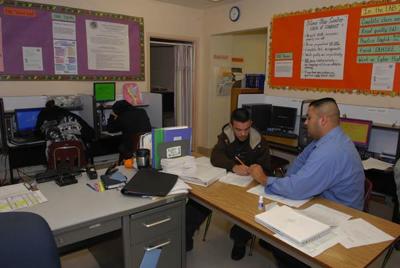
Bob Reyes of the Monterey County Probation Department pulls out a one-sided form describing a Salinas elementary student. Boxes are checked for truancy, failing grades and family problems. The referral is typical of what comes across Reyes’ desk at the Silver Star Resource Center, a multi-agency gang prevention and intervention program in Salinas.
Most of the referred students are in middle school and are missing classes, but are not yet hardened gang members. Families referred to the center can access a network of drug, gang and family counselors as well as teachers and psychiatrists. The support base is meant to steer youth back into the classroom and away from gang recruiters.
“To me it’s kind of getting to them before the gangs do,” Reyes says.
But the county’s only one-stop shop for troubled youth is in financial limbo. Its agencies are awaiting word on whether they will be funded through a federal appropriations bill. Silver Star has a $500,000 allocation in the Labor, Health and Human Services and Education Appropriations bill. But the bill has been stalled by Republican leaders in the House of Representatives because it has a federal minimum wage increase attached to it, says Rochelle Dornatt, chief of staff for US Rep. Sam Farr, who secured the program’s first year of funding.
By the Weekly’s deadline, legislators were expected to extend temporary funding for federal health and education agencies through Dec. 8. For now, special projects like Silver Star included in the approximately $142 billion bill will have to keep waiting, Dornatt says.
• • •
With a badge and handcuffs on his belt, Reyes leads me around the tan-colored hallways of the resource center. The center is located near Natividad Medical Center in the old county-owned hospital site. The probation services manager says parents recall their relatives having surgery in the same rooms where counseling or homework now takes place.
The resource center was launched in April 2005, the same time the Monterey County Gang Task Force hit the streets. It was modeled after the Silver Star program at Rancho Cielo (which is not in financial jeopardy). The center was touted as the prevention and intervention arm of the crime suppression task force. A year and a half later, the Monterey County Probation Department is still stretching out the $1.3 million grant it received from the US Department of Health and Human Services.
A few students enrolled in independent studies sit in a circle and listen to their English teacher. After class, the students can easily walk down the hall to get free access to substance abuse counseling or employment training. With small classrooms and one-on-one settings, the students often develop ties with counselors or teachers that help keep them on track, Reyes says. “The big thing that keeps the kids coming back is that connection,” he says.
The center received more than 860 referrals from April 2005 through August of this year. The top non-school related reason was family problems. This is where Partners for Peace comes in.
The nonprofit group has facilitators that meet with families and children between the ages of 10 and 14 to resolve conflict and strengthen communication. The Strengthening Families Program is split into seven two-hour sessions where the parents and kids do separate workshops for the first half and then come together as a family to apply the skills they learned.
“It gets to the root of the problem,” says Henry Campa, a facilitator for Partners for Peace. “The root is always the love and the respect.”
Jeopardized mental health is another big issue for children at the resource center. More than half of the students who are surveyed also report instances of depression, anxiety, and physical or sexual abuse. To address these issues at a young age, the county’s Children’s Behavioral Health department has a psychiatrist and therapist on site.
• • •
Aurelio Salazar sits in his small office at the resource center staring at a November calendar with half the days crossed out by a pink marker. Salazar is the deputy director of Second Chance, a gang prevention and intervention program. He says their funding is set to dry up at the end of the month.
“I’m looking at this every day,” Salazar says, referring to the calendar. “This is the countdown.”
Although the nonprofit organization has another office in East Salinas, Salazar says the other office is operating at full capacity. Moreover, he says it’s valuable having the different agencies down the hall where the social workers and counselors are familiar with the youth so that the counseling sessions are not a blank slate.
Second Chance, like the other agencies, want to stay at the resource center. Yet there is no long-term plan to fund the programs, which have a total of 18 staff. In salaries alone, this amounts to about $650,000 a year to keep the resource center going at its current level, Reyes says.
Probation Chief Manny Real is hopeful that the resource center will stay open. The different county departments, which include the District Attorney, Behavioral Health, Office of Education, and Social and Employment Services, can possibly pool their resources to fund the center. Local foundations have also been approached for funding.
“We need to find a way to keep it funded and keep it going,” Real says. “If we are providing services to the community…and we shut down, it hurts our credibility.”


(0) comments
Welcome to the discussion.
Log In
Keep it Clean. Please avoid obscene, vulgar, lewd, racist or sexually-oriented language.
PLEASE TURN OFF YOUR CAPS LOCK.
Don't Threaten. Threats of harming another person will not be tolerated.
Be Truthful. Don't knowingly lie about anyone or anything.
Be Nice. No racism, sexism or any sort of -ism that is degrading to another person.
Be Proactive. Use the 'Report' link on each comment to let us know of abusive posts.
Share with Us. We'd love to hear eyewitness accounts, the history behind an article.