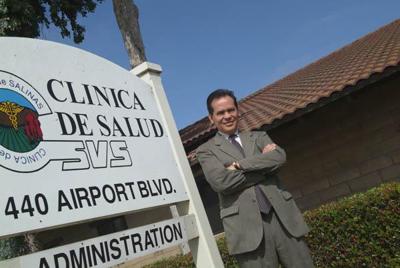
It’s late afternoon at Castroville’s Clinica de Salud del Valle de Salinas health clinic. Patients fill the waiting room. All three dental chairs are occupied; so are the clinic’s six exam rooms. Like all of CSVS’s eight clinics, the Castroville office provides a full range of primary care services, including dentistry and an in-patient hospital, to its patients—mostly families who work in the agriculture industry. “So we rarely ever have to send people off-site,” says Veronica Barajas, a registered nurse, who’s been working at Clinica for seven years.
“We have a lot of patients who don’t have transportation, farmworker people who don’t have insurance, don’t speak English. They feel comfortable here because they know the doctors speak Spanish.”
It’s the same reason Barajas brought her mother to Clinica years ago, after being disappointed during visits to other health centers.
“She was very sick, with a heart problem, and many doctors did not understand her,” Barajas says. “She found help from CSVS. That inspired me to go to nursing school. I wanted to help people who needed it the most.”
For 25 years, CSVS has been providing that service in Monterey County.
Founded in 1980 by a group of community members primarily concerned with providing basic health care to farmworker families, the original clinic was staffed by volunteer nurses and doctors and operated out of two houses in Salinas’ old Chinatown neighborhood.
“Now you go in the clinics and they have state-of-the-art equipment,” says Salinas City Councilwoman Maria Giuriato, who, 25 years ago, was a recent college graduate and CSVS volunteer. “Back then, it was a mish-mash of stuff. People donated the houses, people painted the chairs in the waiting room. Everything was a hand-me-down.”
A couple years later, Dr. Maximiliano Cuevas, CSVS’s current CEO, came out to visit the fledgling operation. “I visited it in those houses on North Main Street,” he remembers. “They asked, how did I like it? I said I didn’t.”
The number of patients being treated at CSVS was growing, and Cuevas wanted the clinic to hire paid doctors and nurses. “I said, ‘The first chance you get, move into a doctor’s office,’” Cuevas remembers. He was a graduate of the UC-San Francisco medical school and Bakersfield/UCLA in gynecology and obstetrics, and a student of community health centers. He wanted to reshape CSVS.
The community members who ran the place followed Cuevas’ advice, first renting an office near Natividad Medical Center, and then, in 1987, buying a large office building in Salinas.
When Cuevas joined CSVS in ‘86, he headed up ob-gyn services. “Back then, we delivered 20 babies a month,” he says. Nine years later, that number is up to 50. CSVS serves 35,000 Monterey County residents and operates on a $15 million dollar budget. Cuevas says about $2 million comes from the federal government, $600,000 from the state.
Some 45 percent of Clinica patients receive benefits from Medi-Cal, and another 25 percent are covered by Medicare or another insurance plan. Between 10 and 15 percent are Medicaid patients. The remaining 15 to 20 percent have no insurance, and pay on a sliding scale, based on income.
“We try to focus on being as efficient as we can,” Cuevas says. “Sometimes we hear patients complain because it can take a long time to get an appointment. The problem is, the demand for health care services is so great.”
CSVS’ list of accomplishments provides a detailed guide on how to provide health care services to underserved populations—in this case, primarily farmworkers.
In 1988, because many patients were traveling into Salinas from South County to receive health care, CSVC opened a clinic in King City, the first facility to provide both medical and dental services in the county. A year later, CSVS became the first “federally qualified” health center in Monterey County, enabling it to provide services to even more patients who cannot afford to pay for the services. For Medi-Cal and Medicare patients, the federal government reimburses CSVS dollar for dollar, for medical services delivered through clinics. (Most private practices only receive 33 cents on the dollar.)
In 1998, CSVS developed the first school-based clinic with a medical provider on site, allowing families with school kids easy access to health care services.
By 2000, CSVS had opened eight clinics—in Castroville, Chualar, Soledad, Greenfield, and two each in Salinas and King City. Approximately 85 percent of the Monterey County population now lives within 15 minutes of a CSVC health center. A mobile medical and dental van provides care for homeless people on the Peninsula and in Salinas.
“We combine a marketing-business tactic with population health,” Cuevas says. “We go out into camps and do screening exams on people—simple little things like a glucose check, because the Mexican population is at extremely high risk for diabetes. While we’re out there, we identify women who are pregnant and plug them into the prenatal services.”
Clinica was one of the first health care providers to use this outreach model to ensure that farmworkers had access to quality health care. Now CSVS works closely with other clinics in Watsonville and in San Benito County to reach a typically underserved population.
The mission is both professional and personal to Cuevas, who was born into a farmworker family in the San Joaquin Valley.
“A long time ago, I realized there’s a need for basic access to health care,” he says. “In doing what I do, in having the clinics perform the way they perform, it allows people access to care who otherwise wouldn’t have it. We do take care of a lot of low-income people. But we would like to think we’re doing it in a way that shows respect and dignity for that person.”


(0) comments
Welcome to the discussion.
Log In
Keep it Clean. Please avoid obscene, vulgar, lewd, racist or sexually-oriented language.
PLEASE TURN OFF YOUR CAPS LOCK.
Don't Threaten. Threats of harming another person will not be tolerated.
Be Truthful. Don't knowingly lie about anyone or anything.
Be Nice. No racism, sexism or any sort of -ism that is degrading to another person.
Be Proactive. Use the 'Report' link on each comment to let us know of abusive posts.
Share with Us. We'd love to hear eyewitness accounts, the history behind an article.