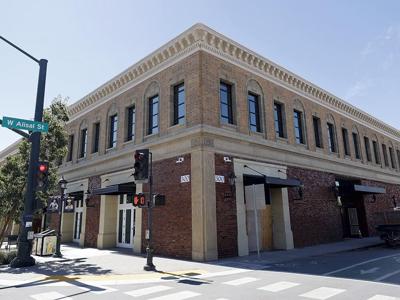

Downtown Salinas is blooming. Construction on Main Street turned the road from a one-way to two ways; iconic buildings are under renovation; outdoor seating is flourishing and a fourth location for Alvarado Street Brewery opens soon in the Rabobank building. New residential units in the upstairs of that building, plus the Dick Bruhn building, will add 69 apartments to the Oldtown housing stock.
Despite this commercial and residential renaissance, the new developments offer no affordable units – by design. In 2017, City Council approved an exemption to the city’s inclusionary housing ordinance to attract developers to downtown. It worked.
Brad Slama, the developer of the Rabobank building, told council on Sept. 13 that it was partly thanks to this exception that he decided to remodel the building. Without it, he said, “I would not have done the project. We would have a blighted, vacant former bank building. They’d be struggling to rent out offices and the ground floor would be in disrepair.”
The inclusionary housing exception doesn’t have an expiration date, but council planned in 2017 to revisit it in five years. Now, City Council is scheduled to consider it on Tuesday, Oct. 18. The question is whether council will end the carveout for Oldtown, or extend the exception, as developers are asking them to do.
“We don’t want to stop development,” City Manager Steve Carrigan says, adding that profits are razor-thin when remodeling buildings.
Many affordable housing advocates in Salinas say the time is up, and the city should keep to its five-year plan and reinstate its requirement. (The city’s current ordinance requires between 12 to 20 percent of units to be inclusionary housing in other parts of the city, depending on if the units are for rent, for sale or both. There are currently 486 affordable units in downtown Salinas.)
One of the goals of having a vibrant downtown area is to make a one-stop neighborhood for residents: A place they can live, work and shop. But there is a catch – not all the people who work in the area can afford to live there.
Jesus Estrada, an organizer with Center for Community Advocacy, a nonprofit that helps empower farmworkers to organize around issues for a better quality of life, says downtown shouldn’t be excluded from providing affordable housing.
“There are people who work here that earn very little. If affordable housing was built [in downtown], they could apply and live closer to where their jobs are,” Estrada says. He and others have organized residents, and dozens appeared at a City Council meeting on Sept. 13 urging them to reinstate the requirement.
City Councilmember Anthony Rocha says the inclusionary ordinance guarantees the city is creating enough affordable housing, and that’s why the downtown exemption should be reevaluated. “It’s critical for the city of Salinas to have consistent laws in place that require affordable housing all throughout our city,” he says.


(0) comments
Welcome to the discussion.
Log In
Keep it Clean. Please avoid obscene, vulgar, lewd, racist or sexually-oriented language.
PLEASE TURN OFF YOUR CAPS LOCK.
Don't Threaten. Threats of harming another person will not be tolerated.
Be Truthful. Don't knowingly lie about anyone or anything.
Be Nice. No racism, sexism or any sort of -ism that is degrading to another person.
Be Proactive. Use the 'Report' link on each comment to let us know of abusive posts.
Share with Us. We'd love to hear eyewitness accounts, the history behind an article.