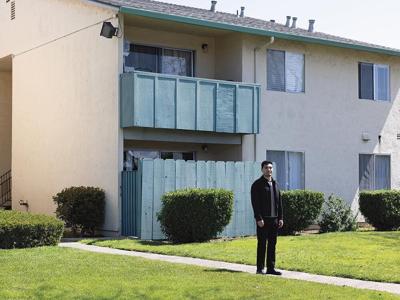

Last year, Salinas became the first city in Monterey County to pass a rent stabilization ordinance. “Today is a historic moment for our city, and it’s a positive change driven by the community,” then-Councilmember Anthony Rocha said on Sept. 24.
But the effort could be short-lived. Rocha was ousted in the November election. A slate of five councilmembers who voiced opposition to the policy, setting a 2.75-percent annual cap on rent increases, were elected.
On March 25, the council showed interest in bringing rent stabilization and the city’s rental registry, established in 2022, back for discussion. Jose Luis Barajas led the way followed by Margaret D’Arrigo, Aurelio Salazar Jr. and Gloria De La Rosa.
Councilmember Andrew Sandoval, who voted in favor of the ordinance, says it’s unfortunate fellow council members want to quash it: “It’ll be a setback. People are already struggling to pay rent.” He believes the policy should be in place for at least a year to collect data and check if rent stabilization is working or not.
Barajas says waiting isn’t an option when there is housing scarcity, voicing concerns that the ordinance could stall new construction and drive owners to sell rental units. “We don’t have to wait for it to become a bigger problem in order to actually do something about it,” he says.
According to a report to Salinas City Council last year by Oakland-based consultant Economic & Planning Systems Inc., “moderate rent stabilization policies with exemptions for new construction find little to no effect on new housing supply.”
Barajas says the city should follow state law, which caps annual rent increases at 10 percent, and it should shift its focus and resources to making sure landlords are following it.
Salinas’ rent stabilization ordinance took effect on Jan. 1, impacting nearly 19 percent of units currently on the market – it applies only to multi-family residences built before Feb. 1, 1995, per the Costa-Hawkins Rental Housing Act, passed by California voters that year.
Renters and landlords have continued to come forward to speak for and against the policy. Three points of contention for landlords are the 2.75-percent increase cap; relocation assistance of three months’ of rent for just-cause evictions; and a rental registry that requires landlords to register units with the city to create a local database to track housing stock. (According to Lisa Brinton, community development director, only about 30 percent have registered as of March 25. The deadline to register a rental without penalty fees was March 31.)
“I strongly urge for the full repeal of the rental registry and rent stabilization ordinance. This policy does not create affordability, it creates barriers,” Mike Handley, owner of Town ‘N Country Realty, told council on March 25.
Nidia Soto is an organizer with Building Healthy Communities, a nonprofit that helped organize residents to advocate for the ordinance. She said in Spanish the ordinance has benefited several families in the city and it has improved their mental health and financial stability noting they “aren’t always worried they will get high rent increases.”
The council is set to discuss the issue on Tuesday, April 22. Options range from keeping it in place, to modifying it, to repealing it entirely.




(2) comments
One interesting 'feature' of the open months of discussion is that owners of houses in Salinas now cannot sell a house if the tenant does not want to leave and the seller cannot find a buyer who wants a tenant. This now seriously limits the seller’s rights and first time new home ownership as that home gets sold to an investor (instead of potentially to a first time home buyer) and as laws, rules, ordinances and regulations become more egregious/expensive fewer small business/family property owners will remain in the market. Housing will become more and more corporate owned. The multi unit (duplex or above) rental registration fees are exceptionally high at $170 per rented unit per year. This is not $170 for the whole building but $170 per individual rented unit in the building. In practice this means with the new annual rent control limit of 2.75% it will likely take three months of an average rent increase of approximately $55/month just to clear this new annual fee. Three months of the annual rent increase will not go to increased maintenance, insurance costs and other costs but will go to the city of Salinas to only cover this new regulatory expense. Potential landlords have already indicated they do not see Salinas as a good or even viable investment for them which again will bode well for corporate ownership. I would like to request the mayor to ensure there is accountability and transparency with how these fees are spent and this annual fee does not become another ever increasing larger burden in the time to come.
Unbelievable, what amount of civic credibility this new Salinas city council and mayor is forfeiting so quickly in its term. First was their multiple Levine Act violations regarding disclosure of campaign funding sources, and now this attempt to reverse good policy for our rent-burdened neighborhoods. The Rental Registry and Rent Stabilization/Tenant Protection ordinances were a product of years' worth of open public discussion and discernment. The city commissioned a Technical Advisory Committee of housing experts who met several times to advise city staff on the ordinances. This TAC was diverse, including realtor groups, builders, developers, union leaders, and affordable housing advocates. The group met as recently as 4 months before the ordinances were approved.
The council has yet to receive any significant quantitative data about these ordinances; instead, they are responding to narrative reports at council meetings from "surprised" non-complying landlords. One has to wonder if the council's motives are ideological, overly pro-market force remedies. This is the kind of thinking that has gotten working-class Salinas in trouble in the first place. To repeal these ordinances 3 months in, would be a hasty, impatient rush to judgment, not consistent with modern leadership!
Welcome to the discussion.
Log In
Keep it Clean. Please avoid obscene, vulgar, lewd, racist or sexually-oriented language.
PLEASE TURN OFF YOUR CAPS LOCK.
Don't Threaten. Threats of harming another person will not be tolerated.
Be Truthful. Don't knowingly lie about anyone or anything.
Be Nice. No racism, sexism or any sort of -ism that is degrading to another person.
Be Proactive. Use the 'Report' link on each comment to let us know of abusive posts.
Share with Us. We'd love to hear eyewitness accounts, the history behind an article.