
Testing nearly a decade ago revealed a wider spectrum of contaminants in the drinking water of households located along Johnson, McGinnis and Live Oak roads in the Royal Oaks area.
Those tests by concerned community members, who in 2021 formed the group Gente Organizada Trabajando por el Agua (People United Working for Water), showed elevated levels of nitrates, 1,2,3-trichloropropane, PFAS, and chromium-6 – the contaminant made widely known through the film Erin Brokovich, and the real-life case that inspired it.
Today, many of those residents rely on bottled water provided by the Community Water Center (CWC), an environmental justice nonprofit that doubles as a technical assistance provider, working with the community on long-term water solutions.
Funding for these solutions through the Safe and Affordable Funding for Equity and Resilience (SAFER) program is paramount. The state program has invested more than $4.5 million in 19 water systems within Assembly District 29 alone. Still, across the region there are 53 failing or at-risk water systems that require funding, including the 219 households served by 116 wells in the Johnson, McGinnis and Live Oak (JML) project area.
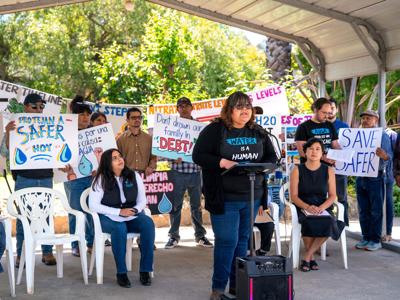
At a press conference on May 15 in Royal Oaks, community partners advocated for the continuation of this funding in the state budget. In the legislative budget approved on June 15, the full $130 million funding request is not included, leaving SAFER with a $62 million funding deficit.
“Thanks to the funding from SAFER we get bottled water, but we know that’s only a short-term solution,” Isabel Morales, a 25-year resident of the Royal Oaks, said in Spanish. “My community and I have been working alongside the Community Water Center to develop a long-term solution. Currently, we are in the design phase, but to get to the construction phase, we are dependent on SAFER receiving the funding every year.”
For the JML area and similar disadvantaged rural communities in Monterey County, many households rely on individual domestic wells. These wells are often shallower than their agricultural neighbors, making them more vulnerable to contamination from natural sources, agricultural runoff and aging infrastructure.
CWC and its partners have identified a solution: consolidating into a nearby regulated public water system. One such project is underway in Moss Landing, connecting 158 households to a system operated by the Pajaro Sunny Mesa Community Services District.
For JML, funding from SAFER would help connect these households to California Water’s existing system in Las Lomas. The project is currently in the design and planning phase, estimated to cost $36 million with a goal start time to begin early 2029.
Roxanne Reimer, water projects director with CWC, says SAFER is unique in its ability to support communities without formal water providers: “Oftentimes, these types of communities get left behind.”


(0) comments
Welcome to the discussion.
Log In
Keep it Clean. Please avoid obscene, vulgar, lewd, racist or sexually-oriented language.
PLEASE TURN OFF YOUR CAPS LOCK.
Don't Threaten. Threats of harming another person will not be tolerated.
Be Truthful. Don't knowingly lie about anyone or anything.
Be Nice. No racism, sexism or any sort of -ism that is degrading to another person.
Be Proactive. Use the 'Report' link on each comment to let us know of abusive posts.
Share with Us. We'd love to hear eyewitness accounts, the history behind an article.