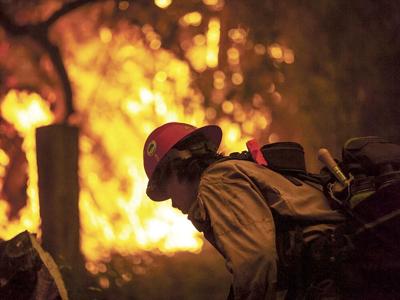

In recent years, wildfire season in California has become as dynamic as the untamed blazes that characterize it.
Californians in 2020 witnessed a record-breaking year for wildfires, which torched more than 4.2 million acres and, at one point, had firefighters battling 367 different blazes at once, according to Cal Fire. The first wildfire of 2020 ignited on Feb. 15 and by April 22, Cal Fire reported 10 fires across the state. Recent data suggests 2021 could be worse. By Jan. 19, Cal Fire already reported 10 wildfires. As of April 20, 19 wildfires have been reported, including five in Santa Cruz County.
Local fire officials say they used to prepare for the season to pick up in early to mid June.
“We’ve gone into the mindset that now it’s almost a year-round fire season,” Monterey County Regional Fire Chief Michael Urquides says. “Every year we say it can’t get worse than the prior year, then the next year is bigger. When you have 4.2 million acres burned the year before, that gets everyone’s attention.”
Predictions of a more severe 2021 fire season are, in part, based on an April study out of San Jose State University’s Fire Weather Research Lab, which found record-low levels of “fuel moisture content” in fire-prone areas. “Fuel” can be any natural material that feeds a fire, from trees and dead logs to grass and leaves. When moisture levels are high, fires are less likely to start; low fuel moisture presents fewer obstacles to ignition.
Fuels are categorized by size and how long it would take air moisture to impact two-thirds of its material. Small fuels, such as grass, are considered 10-hour fuels, while trees and brush could be 1,000-hour fuels. The latter do not ignite easily but if they do they produce substantial heat and are difficult to put out. Jonathan Pangburn, a Cal Fire forester, says the moisture levels for 1,000-hour fuels in the Central Coast region are at record lows.
“The overall outlook calls for above-normal large fire potential in July and beyond,” Pangburn says.
Heightened risk requires heightened preparation. Stacey Wood has lived under the threat of wildfires since she moved into her Robles Del Rio home in Carmel Valley in 2016; as last year’s Carmel Fire spread, she was ordered to evacuate for the first time. Her neighborhood survived, but Wood describes it as a wakeup call.
Robles Del Rio and Rancho Tierra Grande, another vulnerable Carmel Valley community, have since become the first two Monterey County neighborhoods to earn Firewise certification from the National Fire Protection Agency. The designation recognizes neighborhoods that, among other things, have coordinated exit plans and put in the hours to in reduce fuel – removing brush and tree limbs and keeping grass tame – around their homes.
“You can only do what you can do,” says Peter Stern of Rancho Tierra Grande. “The only thing you can do is get your home and property fuel mitigated.”
State Sen. John Laird, D-Santa Cruz, says after 2020’s record-breaking wildfire season, prevention is a “front and center” issue for legislators at the Capitol; however, political battles over funding have been limiting. Laird has introduced SB 456, which would fund statewide fire prevention in five-year increments to avoid belaboring the issue year after year in Sacramento.



(0) comments
Welcome to the discussion.
Log In
Keep it Clean. Please avoid obscene, vulgar, lewd, racist or sexually-oriented language.
PLEASE TURN OFF YOUR CAPS LOCK.
Don't Threaten. Threats of harming another person will not be tolerated.
Be Truthful. Don't knowingly lie about anyone or anything.
Be Nice. No racism, sexism or any sort of -ism that is degrading to another person.
Be Proactive. Use the 'Report' link on each comment to let us know of abusive posts.
Share with Us. We'd love to hear eyewitness accounts, the history behind an article.