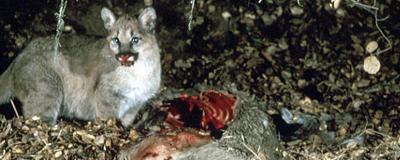
On a typical foggy morning in early July, Kathy Aliotti’s walk with her chocolate lab in Monterey’s Via Paraiso Park took an unexpected turn. As she neared the baseball diamond, she came upon a mountain lion crouching in a gully. The cougar was about the size of her dog, but skinnier, and its gray-tan color blended in with the dry weeds around it.
“It jumped up as though I startled it,” she says. “And it certainly startled me.”
Aliotti isn’t the only local to be surprised by mountain lions this summer. Another cougar, or possibly the same one, was seen near Via Paraiso on July 14 and again near Skyline Crest on July 19. Four days later, the police department received a report that two teenagers spotted a mountain lion while sitting in their car around midnight near Quarry Park.
Urban encounters like these have been on the rise in recent years. A 2004 UC Davis study that followed the movements of 20 cougars in Cuyamaca Rancho State Park in Southern California found that they have adapted to modern life by following park trails, crossing highways and entering suburban areas.
Here in Monterey County, no such study has ever been conducted. But Mark Stromberg, resident director of Carmel Valley’s Hastings Reserve, hopes to secure funding for a similar study that would track 30 cougars in the Santa Lucia and Sierra de Salinas ranges and surrounding Monterey County. The goal would be to learn about the habitat needs of local mountain lions, including the corridors they use to get from one habitat to another.
Preserving cougar habitat may be paramount to maintaining the health of our most valuable ecosystems. “The mountain lion is here to act as the top keystone predator. That’s its job in the ecosystem,” says Lynn Sadler, president and CEO of the Mountain Lion Foundation. “Without the mountain lion, the whole system would collapse.”
That makes Stromberg’s research all the more crucial. “On [Highway] 68, all these homes are being built in mountain lion country. Do the lions still cross through that territory?” Stromberg asks. “Are the fires forcing lions into more urban areas? We don’t know if we don’t study them.”
Terry Palmisano, senior wildlife biologist for the Department of Fish and Game, confirms that some resident lions tend to prowl in urban areas. “Where there are deer, there are probably mountain lions,” she says. “There are always mountain lions, but we usually don’t see them because they are out at night.”
Why cougars have recently been spotted during the day is a mystery. It could be that they were simply unsuccessful in locating food the night before, according to Matt Thomas, an expert tracker and self-defense specialist who has taught in the Monterey area.
Thomas became interested in urban mountain lions when one began appearing in his back yard in Atherton, an affluent suburb near Palo Alto. “The lion started being seen in broad daylight,” he says. “A friend of mine saw it lounging around on his golf course. Finally, it was seen up in a tree near an elementary school.”
As he tracked the cougar and her cub, Thomas came to realize that her behavior was linked to ours. “We are growing at such a rate that mountain lions are being forced to encroach on our territory,” he says.
Since the California Department of Fish and Game began collecting statistics on mountain lion attacks more than a century ago, the state’s population has grown from a little over a million to more than 35 million people. In California, only three mountain lion attacks occurred between 1890 and 1986, according to the Department of Fish and Game, but 13 cougars have attacked people since then. As we grow, we come into greater contact with wild cats.
Whether the mountain lion population is also growing is unknown, because we have no way of counting California’s cougars, Sadler says.
Nationwide, 14 people have been killed in the past 100 years by mountain lions. By contrast, 4,000 people were killed by bees, 10,000 by deer and 1,300 by rattlesnakes.
The statistics were of little consolation to Aliotti as she walked briskly away from the mountain lion in Via Paraiso Park. She hadn’t turned around to see if the cougar was following her, but she had a feeling it was there. “The crows were going crazy like they do when they see my cat at home,” she says.
She kept up her quick pace as she looked for a place to hide. Eventually, Aliotti and her dog ducked into a tool shed. “I know you’re not supposed to run,” she says. “You’re supposed to confront it and look big, but it was hard not to run.”
Officials maintain that we have to keep such sightings in perspective. “This is the only incident we have had where the cougar showed unusual behavior. It didn’t do what we’d expect– run away,” says Monterey Deputy Police Chief Phil Penko.
Domestic dogs kill 20 people and send 500,000 to emergency rooms each year, Sadler notes. “We tolerate this because we, as a society, have decided that it’s worth it in order to have dogs as pets,” she says.
Stromberg concurs: “The perceived risks that people have are grossly distorted from real risks. People’s fears about nuclear fallout and plane crashes far outweigh fears about real risks like car accidents.”
Cougars typically avoid humans at all costs, Stromberg says. He recalls one field researcher who moved closer to a mountain lion and her cub to get a good picture. Then he tripped and dropped his camera, which rolled into the cub. “Imagine this mother cougar watching this bungling 20-year-old college student come towards her and her cub,” Stromberg says.
Despite the insult, the mother cougar showed no aggression. In fact, over the course of 60 years of field research in the wilderness at night, no one has been attacked by a lion, Stromberg says. Of more than 100 observations of mountain lions on Hastings Reserve, he says, a cougar has never even approached a human.
Recent sightings in Monterey remind us that cougars live nearby, but Sadler says that’s no reason to be afraid. “Mountain lions bed down only feet away from people’s homes,” she says. “If we were on their menu, we’d be losing a person a day.”
HOW TO AVOID ENCOUNTERING A MOUNTAIN LION:
Don’t hike alone, and make noise to avoid surprising a lion
Avoid hiking at dawn or dusk when lions usually hunt
Keep children and pets near you
Do not feed deer or raccoons which may attract lions to the area
Deer-proof your landscaping
Install motion-sensitive lighting around your house
Provide sturdy, covered shelter for sheep, goats and other domestic animals
IF YOU DO ENCOUNTER A MOUNTAIN LION:
Don’t approach the lion, and don’t run or turn your back
Appear as large as possible by raising your arms and spreading your jacket
Wave your arms and speak loudly
Throw whatever you can reach without bending over
Back away slowly and give the lion an escape route
Fight back if attacked
SOURCES: California State Parks, California Department of Fish and Game


(0) comments
Welcome to the discussion.
Log In
Keep it Clean. Please avoid obscene, vulgar, lewd, racist or sexually-oriented language.
PLEASE TURN OFF YOUR CAPS LOCK.
Don't Threaten. Threats of harming another person will not be tolerated.
Be Truthful. Don't knowingly lie about anyone or anything.
Be Nice. No racism, sexism or any sort of -ism that is degrading to another person.
Be Proactive. Use the 'Report' link on each comment to let us know of abusive posts.
Share with Us. We'd love to hear eyewitness accounts, the history behind an article.