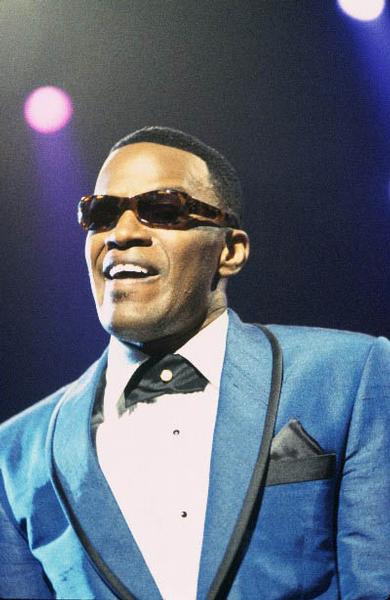
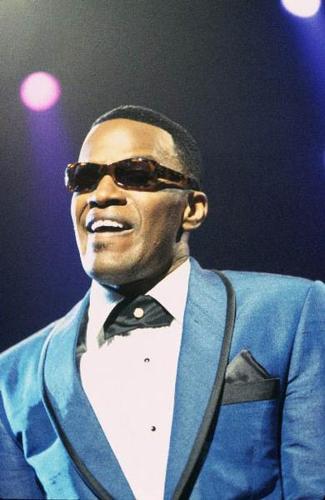
The music of Ray Charles is a national treasure, as is the artist’s legacy. The same can’t be said for Ray, the movie of his life, although the transcendent performance of Jamie Foxx as Ray Charles kicks this otherwise ordinary biopic into the realm of the extraordinary.
RAY ( * * * )
Directed by Taylor Hackford
Starring Jamie Foxx, Kerry Washington, Regina King, Clifton Powell, C.J. Sanders, Curtis Armstrong, Richard Schiff, Larenz Tate
(Rated PG-13, 152 min.)
Foxx positively inhabits Charles: His physical mannerisms and vocal inflections are so close to the real thing that it becomes possible to forget you are watching an actor playing a musician. Foxx also does his own piano-playing in the movie, and even though we know he lip-syncs the songs, it is virtually impossible to tell. Enough can’t be said about the performance, which is certain to be remembered as end-of-the-year awards time approaches. The movie, however, follows a pedestrian biopic path, recounting the early struggles of the artist, his dual addictions to heroin and women, and his ultimate redemption and embrace as a beloved American icon.
Despite the movie’s 2 1/2-hour running time, Ray concludes well before Charles’ death this past summer, making it seem like the movie’s almost fairy-tale episode of Charles kicking heroin is the real end of this story: It’s the kind of rise, fall, and redemption pattern that has become familiar to any casual watcher of TV’s Behind the Music-type shows.
However, director Taylor Hackford is no newcomer to the rock ‘n’ roll saga. Among his previous credits are the rock movie gems Chuck Berry Hail! Hail! Rock ‘n’ Roll and The Idolmaker. The story of Charles’ early years—his early blindness, the death of his brother, the adventures on the Chitlin’ Circuit, battles against Jim Crow restrictions, womanizing, drugging, marriage and family, a child out of wedlock, jail, and so on—make for engaging storytelling, but after a while it just seems like more of the same. It’s as if this always-original stylist who become a fixture in the American musical firmament—the story of the last decades of his life—lacks enough drama or scandal to make it worthy of our attention.
Ray makes the mistake of tying every song used in the movie (and it uses many) to some real event in his life, as though each tune was written as a direct response to something concurrent. Also, the film employs the same hoary technique used in other show-biz movie biographies due out later this year, namely Beyond the Sea (Kevin Spacey’s tribute to Bobby Darin) and The Life and Death of Peter Sellers: All three show their adult heroes as actively engaged in ongoing struggles with their childhood selves, a strategy that gives corporeal presence to their ingrained life problems.
Despite its formulaic filmmaking and redundancies, Ray can be a blast to watch. All the supporting performances are excellent, and when the music is cooking the movie really comes alive. As a story about the difficulties of a black artist finding success in segregation-era America, Ray is also enlightening. No matter the movie’s pitfalls, Ray, we can’t stop loving you.


(0) comments
Welcome to the discussion.
Log In
Keep it Clean. Please avoid obscene, vulgar, lewd, racist or sexually-oriented language.
PLEASE TURN OFF YOUR CAPS LOCK.
Don't Threaten. Threats of harming another person will not be tolerated.
Be Truthful. Don't knowingly lie about anyone or anything.
Be Nice. No racism, sexism or any sort of -ism that is degrading to another person.
Be Proactive. Use the 'Report' link on each comment to let us know of abusive posts.
Share with Us. We'd love to hear eyewitness accounts, the history behind an article.