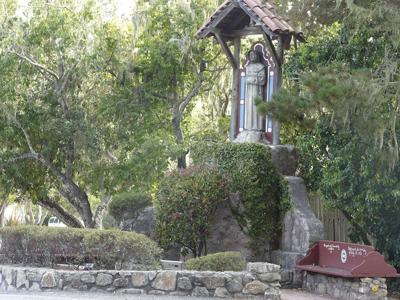

The wooden niche with a Spanish red-tiled roof at the intersection of Camino del Monte and Alta Avenue just outside of Carmel sits empty. Gone is its icon, a statue of Father Junipero Serra, carved from oak by renowned artist Jo Mora nearly 100 years ago. For now the statue is in safekeeping with the city of Carmel, after nationwide Black Lives Matter protests last year spilled over into targeting monuments to Serra.
Serra founded the California mission system in 1769, subjugating thousands of Indigenous people. The Carmel Mission, originally founded in 1770 in Monterey, was moved a year later by Serra to the mouth of the Carmel River. While the church canonized him as a saint in 2015, he is seen as a sinner to many who point to the harm he brought to California’s original residents.
No one questions Carmel City Administrator Chip Rerig’s judgement in removing the statue, but questions now loom over what will become of it and who owns it. The statue didn’t sit within Carmel’s city boundaries, but over the 98 years it was displayed the city took over some of its care, in partnership with the Carmel Woods Neighborhood Association that represents the residents who live in the unincorporated enclave.
The association now wants Father Serra back in his niche, says Mark McDonald, CWNA president. A survey of residents shows that 74 percent support returning the statue. Some said a copy of the statute would be acceptable. Over 65 percent said they were willing to pay for any expenses involved.
The CWNA has a solid claim for ownership, considering the statue was commissioned by Samuel F.B. Morse of the Del Monte Properties Company – forerunner to Pebble Beach Company – specifically for the grand opening of Carmel Woods. Two other entities could also stake a claim: Pebble Beach Company and the Diocese of Monterey. (A Diocese spokesperson says that if the city were to consider gifting the statue to them, “we would be happy to be considered.”)
Ownership aside, the thornier question may be where the statue belongs, given Serra’s legacy. Jo Mora Trust Collection Curator Peter Hiller believes it might be best within the walls of the Carmel Mission. “That’s an appropriate place to put it. Not that it’s less controversial, but at least it doesn’t become an attractive nuisance,” he says.
McDonald acknowledges the controversy and says he respects the “strong feelings” of others, “but this statue ties our community together and we see it in that light.”
For Louise Miranda Ramirez, chairperson of the Ohlone/Costanoan Esselen Nation, the statute doesn’t build community, it divides it by ignoring the past. “It’s so easy for them to say it’s a part of history, but it’s not a part of history when it comes to our people who were here for thousands of years,” she says.
Rerig says no decision has been made yet about what the city will do with the Mora statue, or another Serra statue removed from Devendorf Park. The matter is scheduled for a City Council discussion Sept. 7.


(0) comments
Welcome to the discussion.
Log In
Keep it Clean. Please avoid obscene, vulgar, lewd, racist or sexually-oriented language.
PLEASE TURN OFF YOUR CAPS LOCK.
Don't Threaten. Threats of harming another person will not be tolerated.
Be Truthful. Don't knowingly lie about anyone or anything.
Be Nice. No racism, sexism or any sort of -ism that is degrading to another person.
Be Proactive. Use the 'Report' link on each comment to let us know of abusive posts.
Share with Us. We'd love to hear eyewitness accounts, the history behind an article.