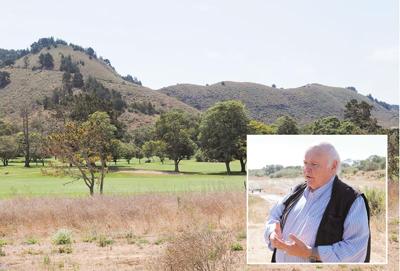
Last we heard about Rancho Cañada Village, it was a talking point in the ballot initiative for Carmel Valley incorporation. But voters never did approve the new town, leaving the county in charge of Carmel Valley land-use decisions such as the proposed residential subdivision.
Not long after that 2009 vote, the Carmel Valley Association (CVA) sued over parts of the county’s 2010 General Plan, putting Rancho Cañada Village on hold. Now, the developer says, he plans to resubmit the application to the county.
The original application called for 281 new units, half designated affordable, and open space on 81 acres east of the intersection of Highway 1 and Carmel Valley Road. In spring 2008, a ream of public comments, including from the CVA, blasted the draft environmental impact report (DEIR). Among the concerns: water rights, climate-change impacts, discharge into the Carmel River, flood risks created by fill, traffic congestion and potential health impacts.
Developer Alan Williams of Carmel Development Company rejected the DEIR, saying it was inaccurate. That put the application on hold, and nothing has happened with it since.
“We’ve been in limbo until they say, ‘Move forward,’” County Planner Jacqueline Onciano says.
In fall 2009, land-use activists protested Rancho Cañada as it related to Measure G, a failed ballot measure to incorporate as the Town of Carmel Valley. Proponents of incorporation felt dense residential projects should be decided by valley representatives, not the county supervisors.
Although it lost the ballot fight, the Carmel Valley Association challenged the county’s 2010 General Plan over the traffic-counting method on Carmel Valley Road, alleging it would inflate the acceptable level of traffic and allow more development. The lawsuit was settled in September 2012, directing the county to adjust how it counts cars and also reduce the maximum number of new units in Carmel Valley over the next 20 years from 266 to 190.
Twenty-four of those units are already reserved for the Carmel Valley Airport property, CVA board member Christine Williams explains by email. “Presumably most of [the remaining 166] would be taken up with [Rancho Cañada Village],” she writes. “But we know nothing of what they will be proposing. Until we see that proposal, we can’t really comment.”
Alan Williams, who’s developing Rancho Cañada with Clint Eastwood, says he plans to resubmit the application in one to three months. The proposal had already been scaled back from 281 to 180 homes, he says; considering the settlement’s cap on new units, the next application will be for even fewer. “I guess if I build my project, they don’t have to build anything else ever,” he jokes.
Williams suggests the re-application will also show a reduction in workforce housing. “You take numbers away, you can’t pay the bills,” he says. “I’ve been at this now for eight or nine years. I’ve got lots of money in it.”
Onciano says Cañada’s combined development permit was deemed complete in 2005 but hasn’t been approved. “If [Williams] works on his EIR and gets it approved, then yes, he’s first in line,” she says. “He’s well ahead of everybody.”
When the applicants ask the county in writing to proceed, Onciano says, the DEIR will be amended and recirculated.


(0) comments
Welcome to the discussion.
Log In
Keep it Clean. Please avoid obscene, vulgar, lewd, racist or sexually-oriented language.
PLEASE TURN OFF YOUR CAPS LOCK.
Don't Threaten. Threats of harming another person will not be tolerated.
Be Truthful. Don't knowingly lie about anyone or anything.
Be Nice. No racism, sexism or any sort of -ism that is degrading to another person.
Be Proactive. Use the 'Report' link on each comment to let us know of abusive posts.
Share with Us. We'd love to hear eyewitness accounts, the history behind an article.