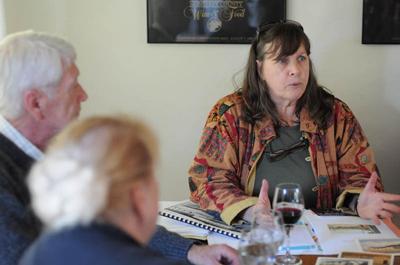
Over wine and cheese on an August afternoon last year, Estevan Rael-Gálvez spoke to a small assembly of volunteers, preservationists and city officials in the garden behind Monterey’s Cooper Molera adobe.
He quoted Aristotle on the meaning of “place” and philosophized about the trouble with house museums, like Cooper Molera, selecting one specific period in time to immortalize. “It should be vibrant, full of life,” he said.
Rael-Gálvez is vice president of historic sites for the National Trust for Historic Preservation, the Washington, D.C.-based nonprofit that owns the 19th-century adobe, and is considering big changes to Cooper Molera.
“I value volunteerism,” Rael-Gálvez told the group. “Tonight is all about drawing you to the table.”
Nearly a year later, some of those volunteers aren’t convinced they have a seat at the table. To make the point they want one, they’ve contacted a historic preservation attorney, Susan Brandt-Hawley, who successfully fought to keep Flanders Mansion in Carmel as city property.
The Alliance of Monterey Area Preservationists (AMAP) met June 13 at Board President Mike Dawson’s house to discuss strategy (and the lawyer), but Dawson isn’t sure of their chances. “We’re in a position of no leverage,” he says. “We don’t own it, so we really don’t have a say in what happens to it.”
The Trust owns Cooper Molera and contracts with California State Parks to operate the property; State Parks takes about a $1.5 million loss to maintain Cooper Molera and another 12 downtown adobes in Monterey.
National Trust representatives and their local PR rep, David Armanasco, met privately with volunteers and history advocates earlier this month. They introduced a proposal by developer Doug Wiele of Foothill Partners, who leases the adjacent parking lot from the National Trust for his Trader Joe’s shopping center. Wiele’s plans for Cooper Molera include a cafe, a restaurant and retail space.
“It’s just shocking and silly. It’s not a good idea,” AMAP Treasurer Nancy Runyon says. “We’re all a little scared.”
In a different sense, so is the National Trust. The organization wants to transform historic properties around the country into revenue-generators. It’s something trust officials were already considering when Wiele approached them in 2010. The proposed kitchens would be free-standing so they could be removed at a later date. Water credits, though, remain an unanswered question.
Todd Lewis, acting director of the Monterey District of State Parks, expects State Parks would still have some interpretive role at a reconfigured Cooper Molera, and it could free up resources to tend to other adobes.
“We’re hoping we can have our cake and eat it too,” he says.



(1) comment
As I understand it, Frances Molera deeded the property to the National Trust when she died in 1968 with the stipulation that it not be used as a restaurant. What about their blatant disregard for her wishes in considering this developer's proposal?
Welcome to the discussion.
Log In
Keep it Clean. Please avoid obscene, vulgar, lewd, racist or sexually-oriented language.
PLEASE TURN OFF YOUR CAPS LOCK.
Don't Threaten. Threats of harming another person will not be tolerated.
Be Truthful. Don't knowingly lie about anyone or anything.
Be Nice. No racism, sexism or any sort of -ism that is degrading to another person.
Be Proactive. Use the 'Report' link on each comment to let us know of abusive posts.
Share with Us. We'd love to hear eyewitness accounts, the history behind an article.