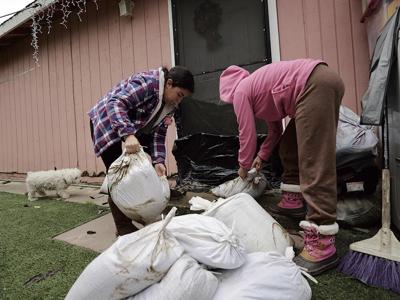

As cleanup continues in the community of Pajaro, where evacuation orders lifted on Thursday, March 23, the town looks anything but clean. Streets are full of mountains of trash, with broken furniture, refrigerators and toys covered in mud blocking parking spaces and making it difficult for cars to transit.
That is the aftermath of the widespread flood that left much of Pajaro underwater on March 11 after the Pajaro River levee broke, leaving many residents away from their homes for 12 days, and effectively stranding those who refused to leave.
On Monday, March 27, farmworker Marisela Ortiz Merino is on Cayetano Street taking pictures of her dad’s truck before calling the insurance company. She and her parents, with her sister’s family, lived in a garage that was converted into a two-bedroom, which they rent from relatives. The small home now is bare bones: no appliances, furniture, exposed wall frames. The kitchen cabinets and several mugs and glasses on a fixed table are the only traces that someone lived here.
Their home is uninhabitable. Ortiz Merino says in Spanish they are all staying in a room in Salinas. “We lost everything,” she says. “We have no place to live.” The family has been looking for a new home for over a week, but rents are through the roof: $2,500 or more per month. Ortiz Merino says it is hard to see everything they worked so hard for gone in a second: “It breaks my heart.”
“The government knows that thanks to us [farmworkers], the country stands up,” Ortiz Merino adds. “Without farmworkers, the country collapses.”
On March 23, dozens of families returned to check on their homes and belongings for the first time since the flood. Ruth Ruiz and her mom, Maria Ponce, opened the gates and walked into their homes. Ponce’s home, which is at a higher elevation, had only a little water in the laundry area. Ruiz and her mom removed sandbags in front of Ruiz’s apartment door. They went inside, and Ruiz wasn’t as lucky: Water had gotten into her one-bedroom unit. The place has a musky smell, mud and water on the carpet, and mold was growing on her shoes.
“I can’t come home,” Ruiz says. She thinks it will take months before she can again occupy her unit. The insurance company has to come in and assess the damage – something that won’t happen until the beginning of April.
Ruiz was keeping her emotions in check, but breaks down when she reunites with her sisters. They hug each other and cry. Despite the swirling emotions, Ayerette Ruiz has a narrow smile – she is relieved to discover her home is OK. “We are happy to be home and start our cleanup process,” she says. “You never really realize what Pajaro means to you until you don’t have Pajaro.”
While residents and business owners face challenges moving back in, the Monterey County Board of Supervisors voted on March 28 to approve a temporary eviction moratorium for Pajaro tenants impacted by the flood, in effect through Aug. 31.
Also on March 28, Gov. Gavin Newsom asked President Joe Biden to issue a federal disaster declaration for Monterey County – more than two weeks after the flood. With no federal aid presence, the county opened a disaster assistance center in Watsonville on March 29, that will operate until at least April 7.


(0) comments
Welcome to the discussion.
Log In
Keep it Clean. Please avoid obscene, vulgar, lewd, racist or sexually-oriented language.
PLEASE TURN OFF YOUR CAPS LOCK.
Don't Threaten. Threats of harming another person will not be tolerated.
Be Truthful. Don't knowingly lie about anyone or anything.
Be Nice. No racism, sexism or any sort of -ism that is degrading to another person.
Be Proactive. Use the 'Report' link on each comment to let us know of abusive posts.
Share with Us. We'd love to hear eyewitness accounts, the history behind an article.