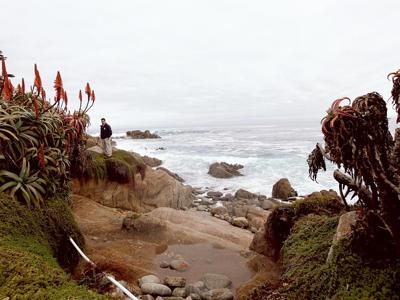

On Dec. 11, as a powerful storm brought pounding surf to Pacific Grove shores, part of Ocean View Boulevard was closed for six hours as waves spilled over the road. High surf road closures on Ocean View happen from time to time, says Pacific Grove Public Works Director Daniel Gho, but aside from being a minor inconvenience to residents, the surf brings a far more costly impact: erosion.
In some senses, Pacific Grove is better off when it comes to erosion than the shores of southern Monterey Bay, which is eroding at a rate of about 4 feet annually, the highest erosion rate in the state (see cover story, p. 20). The city’s shoreline is built atop granite bluffs that erode over millenniums, not decades, and which act as a bulwark against relentless wave action.
But in many places along P.G.’s shore, above the granite bluffs is a layer of what’s called “terrace deposits,” a compacted mixture of clay and sand susceptible to erosion caused by the surf. And at one place along Ocean View Boulevard, that erosion is threatening to undermine the road.
On a recent morning, Gho points out three locations near Esplanade Park where erosion is beginning to threaten the road, and where the walking trail along the coast has long since been swallowed by the sea. In some places, the trail is lost for more than 50 feet, forcing pedestrians onto the road.
At the location with the worst erosion, where there’s a cavity that recedes all the way to the street, Gho says the city got an emergency waiver from the California Coastal Commission about a year ago to put in two granite boulders in an attempt to slow the erosion.
“The road has sewer lines and storm drains running under it,” Gho says. “It’s got a lot of money in the infrastructure.”
Before approving a plan to deal with erosion, the Coastal Commission requires engineers to look at three possible courses of action: armoring (with a seawall or riprap), retreat (moving the trail or road back) or doing nothing.
On Jan. 20, Pacific Grove City Council will consider funding a study to examine these alternatives at the three Esplanade locations, as well as three more at Sea Palm Park that Gho identifies as a priority.
Generally, the Coastal Commission favors retreat over armoring, as armoring can increase erosion elsewhere. But in some of the eroding Pacific Grove sites, retreat would mean either moving the road further from the shore – a challenge given that there are homes on the other side – or taking it down to one lane.
For Mark Foxx, an engineering geologist who developed plans for seawalls at 18 locations in Pacific Grove in 2004 – and whose firm has submitted a proposal for the study – the key is maintaining public access, and he doesn’t think seawalls at the six locations would greatly affect erosion elsewhere.
“The proposed work is small enough that I would characterize that impact as being insignificant,” he says, and adds there’s no time to waste.
“In a single El Niño winter, quite a bit of erosion can occur, 8 or 10 feet,” he says. “At one of the spots near Esplanade, the road could have been undercut during the extreme storms we had last week. We’ve had some very large swells that have come in, and more are anticipated. There’s no margin of safety.”


(0) comments
Welcome to the discussion.
Log In
Keep it Clean. Please avoid obscene, vulgar, lewd, racist or sexually-oriented language.
PLEASE TURN OFF YOUR CAPS LOCK.
Don't Threaten. Threats of harming another person will not be tolerated.
Be Truthful. Don't knowingly lie about anyone or anything.
Be Nice. No racism, sexism or any sort of -ism that is degrading to another person.
Be Proactive. Use the 'Report' link on each comment to let us know of abusive posts.
Share with Us. We'd love to hear eyewitness accounts, the history behind an article.