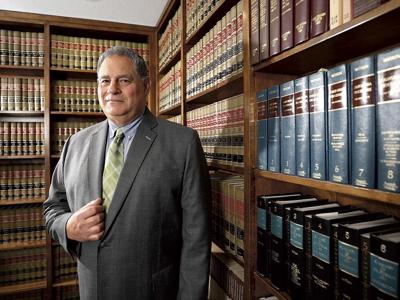

The employee performance review conducted during a Dec. 1 Pacific Grove City Council meeting was behind closed doors but the temper of that review was immediately apparent: The council is not happy with the services of its city attorney of nearly 17 years, David Laredo, after a legal mistake cost the city potentially $1 million or more in lost sales taxes. Mayor Bill Peake tersely reported in open session that the council voted 7-0 to entertain new contracts from any interested attorney or law firm.
Laredo, whose current contract ends in June, declined to comment, saying he heard the announcement at the same time as the public. “This is not unusual,” he says. The P.G. Council has done it before within the last decade, he says: “Public agencies do this on a regular basis.”
His firm, De Lay & Laredo, provides legal services from Laredo as the city attorney, with other members of the law firm filling in as deputies or assistants, as is typical for many cities and special districts that contract the position rather than hire an in-house attorney. The city’s 2021-22 budget lists $491,000 for the city attorney’s office, a majority of which pays for De Lay & Laredo’s hours plus the services of outside firms when needed.
Last year Laredo was tasked by the council with writing a ballot measure designed to raise the sales tax by 0.5 percent, from 8.75 to 9.25 percent, with the potential of bringing in up to $1 million in revenue annually. Measure L passed on Nov. 3, 2020, with nearly 60 percent of the vote. It was supposed to go into effect on Jan. 1, 2021, until the state agency that collects the tax, the California Department of Tax and Fee Administration, refused, saying P.G. used the wrong city tax ordinance in the measure. Laredo took responsibility for the error.
With council approval, Laredo hired an outside law firm with expertise in state tax issues to file a claim and then a lawsuit in April in Sacramento Superior Court, arguing that referring to the wrong ordinance was merely a “scrivener’s error.” Judge Christopher Krueger ruled against the city on Nov. 9. The cost of that outside firm is estimated at $108,000, according to city financial records.
The court judgement left the P.G. City Council with no choice but to take a corrected ballot measure back to the voters. The question on Dec. 1 was whether to take it to a special election next spring, or wait until a scheduled election. “I think we need to go to a special election for the tax right away under a fiscal emergency,” Councilmember Nick Smith said. He rejected the idea of conducting voter polling first, a common practice ahead of putting measures on ballots: “They’ve already voted for it once and supported it with a pretty good majority.”
Council voted 7-0 to put the sales tax measure on a special election ballot on April 5, for 0.5 percent, just like the measure that passed in 2020 but was never enacted.
City Manager Ben Harvey presented two additional ballot measure concepts to consider: allowing a cannabis retail location and promoting affordable housing. Council voted 7-0 to put a cannabis measure on Nov. 8 ballot. They also voted 7-0 to get more information about a potential affordable housing measure for the November election.



(0) comments
Welcome to the discussion.
Log In
Keep it Clean. Please avoid obscene, vulgar, lewd, racist or sexually-oriented language.
PLEASE TURN OFF YOUR CAPS LOCK.
Don't Threaten. Threats of harming another person will not be tolerated.
Be Truthful. Don't knowingly lie about anyone or anything.
Be Nice. No racism, sexism or any sort of -ism that is degrading to another person.
Be Proactive. Use the 'Report' link on each comment to let us know of abusive posts.
Share with Us. We'd love to hear eyewitness accounts, the history behind an article.