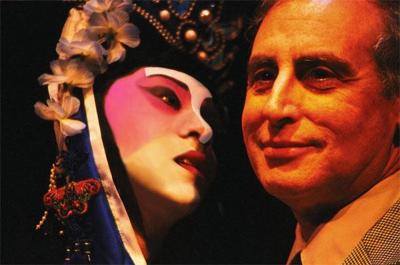
Sexual fantasy can be a powerful opiate. It can weave a silken cocoon around a man, completely snuffing the light of reality. And it can change him. If the delusion of wings is powerful enough, a man will try to fly.
Pac Rep’s production of David Hwang’s 1988 masterpiece M. Butterfly, which closes this weekend at the Golden Bough Theater, deftly spins a tale of a hapless man caught in the complex web of his own desires and the socio-political machinations of Maoist China.
At its most basic, M. Butterfly interprets the true story of a French diplomat who falls in love with a Peking opera star only to be deceived, manipulated and eventually humiliated and jailed.
The play opens with Rene Gallimard (Michael D. Jacobs), seated in his cell ostensibly imagining the “perfect” (i.e. sympathetic) audience before him. A low-ranking diplomat in early-’60s Beijing, he is the laughingstock of the world, he tells us. At cocktail parties he is derided as the foolish diplomat whose china-doll lover was not just a communist spy, but a man.
But hear me out, Gallimard pleads, see it my way. And we do.
Against Ramie Wikdahl’s exquisite set design, which manages to evoke both a Chinese temple and the warped perceptions of Monsieur Gallimard, Hwang’s script lambasts Western stereotypes, with withering allusions to Puccini’s classic opera Madama Butterfly, while revealing how a man can turn his back on painful truth to embrace a damning, if beautiful, lie.
Gallimard lives a dull, practical life until he happens upon Song Liling (K. Liu) performing an aria from Puccini’s opera—which tells the story of a sailor named Pinkerton who comes to Japan, marries a local beauty, gets her pregnant and then abandons her to suicide. Gallimard is mesmerized by Song Liling’s performance and afterwards, when she approaches him, he is surprised to find himself at ease with her, even when she tells him she loves Madama Butterfly because it’s about Oriental submission, fantasy and the rape mentality of a nation.
Gallimard listens in amused horror as she asks him to imagine the story from a different perspective—one in which a short, ugly Japanese businessman comes to America, marries a blonde homecoming queen, knocks her up and moves back to Japan.
It’s a sobering interpretation, but instead of clarifying his situation, it works instead as a jumping off point into delusion. Gallimard finds himself drawn to the fantastic world of the Peking opera where, swaddled in smoke, Song Liling wields a hypnotic and alluring power.
As his relationship with the opera star grows ever more convoluted and involved, the secret gets out within the French embassy that he has a Chinese lover. Instead of ruining him, Gallimard is surprised to find, the affair furthers his career. I’m finally beginning to understand the world of men, he tells us. And that’s the rub—Gallimard allows himself to overlook the obvious because the rewards are too intoxicating. Not only does he finally command respect among other men, but he has power over a beautiful woman for the first time in his life. Gallimard’s great crime is that despite full comprehension of the grotesque Pinkerton archetype, he ultimately becomes Pinkerton.
Yet Hwang’s brilliant script forces reality to penetrate Gallimard’s Puccini-esque fantasy in the form of the Cultural Revolution. As a Maoist spy, Song Liling is equally doomed. Mao has gone senile and the revolution has degenerated into widespread persecution. As a homosexual, this puts Song Liling in a tenuous situation.
To survive, she must continue to produce classified information. Unfortunately, Gallimard’s shaky grasp on reality extends into his socio-political forecast for the Viet Nam situation and his credibility is destroyed, sending him home to Paris and Song Liling to a brutal work camp.
Back home and deprived of his fantasy, Gallimard lapses into depression and divorces his wife. So when Song Liling arrives on his doorstep courtesy of Maoist intelligence, he takes her in without question, ultimately dooming himself.
Stephen Moorer and Ramie Wikdahl’s direction is spot-on, capturing the contrasting colors and atmosphere’s of Gallimard’s fantasies and the story’s grim realities. Their cast is top-notch. As Gallimard, Jacobs is outstanding at producing the empathy necessary to make the whole play work. He easily moves from era to era, from first-person introspection to third-person narrative, from Gallimard to Pinkerton.
As Song Liling, K. Liu is also remarkable. Although it takes some suspension of disbelief to imagine him as an attractive woman, his performance is otherwise impeccable. His voice and movements and attitudes are tremendous. It’s a bravura performance that carries the play.
The supporting cast is excellent as well. Steven Slack’s character acting is superb and, as Mark, he is absolutely hysterical. Mia Tagano wields the club of realism with a vengeful rage as Comrade Chin, while providing some light moments as Suzuki as well. And Mary Ann Schaupp-Rousseau delivers a nuanced and affecting performance as Gallimard’s wife, Helga.
Hwang’s play is important. Beyond all its sexual politics, M. Butterfly is ultimately a story of great bravery.
M. Butterfly closes this weekend with 7:30pm shows Friday and Saturday at The Golden Bough Playhouse, Monte Verde between 8th and 9th, Carmel. $22-$30/adults; $15-$25/seniors andstudents; $6 for children under 12. 622-0100, www.pacrep.org or www.ticketguys.com.


(0) comments
Welcome to the discussion.
Log In
Keep it Clean. Please avoid obscene, vulgar, lewd, racist or sexually-oriented language.
PLEASE TURN OFF YOUR CAPS LOCK.
Don't Threaten. Threats of harming another person will not be tolerated.
Be Truthful. Don't knowingly lie about anyone or anything.
Be Nice. No racism, sexism or any sort of -ism that is degrading to another person.
Be Proactive. Use the 'Report' link on each comment to let us know of abusive posts.
Share with Us. We'd love to hear eyewitness accounts, the history behind an article.