
On Halloween, the night before her first day on the job, Alison Vilag opted for a dark-and-stormy cocktail at the Sandbar & Grill, a favorite pitstop with friends when she’s in town for the migration. It is a spiritual decision of sorts, to summon ideal weather for birds soon to be traveling south.
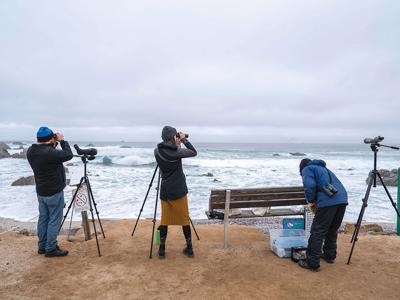
Vilag is a counter, and her goal is simple until it’s not: to count the birds flying overhead. For six weeks, six days a week, Vilag stands out at Point Pinos in Pacific Grove from dawn to dusk. Sunday is her rest day. She is adorned with layers strategically chosen throughout the season to fight the marine chill. An assortment of counting mechanisms are in designated pockets.
Through a mix of telescopes and binoculars, her eyes are fixated on the sky. In the event too many birds pass by at once (previous counters have mentioned seeing hundreds of thousands of just one species in an hour) Vilag must know exactly where each clicker is, to count without pause.
“It is humbling to stand out there and just have birds everywhere, and realize that you’re the person that’s supposed to identify them and put them into numbers,” Vilag says.
Every year from Nov. 1 until Dec. 15, the Monterey Peninsula becomes one of the most ideal locations in North America to view an avian passage unique in species and magnitude. The geography of Monterey Bay funnels birds along a specific route over nutrient-rich waters, making Point Pinos an optimal vantage point for spotting birds midstream from extreme northern regions as far as the Arctic.
The Seawatch program, run by the Audubon Society and now in its 10th year, was erected with this understanding – orchestrating an annual count of all birds passing by, with an emphasis on two in particular, the Pacific loon and the surf scoter.
While certain preparations can be made in the weeks before such a job, true readiness is perhaps cultivated over time and as a lifestyle. Vilag first remembers being interested in birds when she was 6 years old, with an owl. It was a “very, very long time” until she saw that particular kind of owl again, she notes.
But it was in her early high school years that she began leaning in, learning how to identify migrating birds nearby where she lived, about 10 miles from Lake Michigan. Long, still hours spent watching the sky led her to conduct bird surveys in the spring and fall at Whitefish Point Bird Observatory, on Michigan’s Upper Peninsula.
In the birding world, she explains, counting at Whitefish Point is colloquially considered the equivalent of an undergraduate degree; Cape May, New Jersey, is graduate level; and Point Pinos “might as well be your postdoc.” Now 33 and in her fourth season – having skipped Cape May – Vilag is beginning to enjoy the parts of the count that once intimidated her.
“It’s a really small network of people,” she says. “Not only who know how to do this, but also have the mental fortitude to stand out in all sorts of conditions and keep focus and always be looking for movement, even on days when there’s not a lot of things moving.”
Before her first season at Point Pinos, Brian Sullivan, a board member with the Monterey Audubon Society, took Vilag out for an orientation of sorts. He pointed out all the different places where loons might be flying in the sky. Pacific loons are unique in that they breed in the arctic tundra and travel south to feed, often congregating in areas inaccessible to humans, making Monterey County’s coastline the one place to get a sense of their total population numbers.
Surf scoters, abundant birds with vibrant orange bills – the males with a white patch on the back of their heads – are used to monitor the health of the ecosystem. “Some people call them skunk ducks,” Vilag adds.
“Loon hour” generates some buzz, but for Vilag, initially translated to unease. The rising sun – unless there’s a strong weather event – brings with it the highest volume of not just loons, but other species as well.
“That first whole year I never really enjoyed loon hour until it was over,” Vilag says. “I would wake up and see the sun starting to come up in the sky, and I would just sort of steel myself, like, OK, it’s coming – it’s going to be a lot of birds and a lot to keep up with. And I hope that I can do this.”
Her presence – alongside volunteers who often accompany her framed by an array of scopes and a bench covered in thermoses and snacks – elicits attention from curious passersby. Greg Farley, an ornithologist who assists with the count, flips through his notebook as Vilag and another volunteer spot a surf scoter flying by. He’s counting people, tracking the number of humans that they engage with on a daily basis and doubling as a friendly buffer to allow Vilag to do her job, uninterrupted. After tallying birds, Vilag enters the data along with narrative details and daily notes into eBird, an online global bird database. Her data entries are accessible by many, including conservation researchers and the broader birding community.
“There was a counter the year before me that had almost 100,000 Pacific loons go by in a single hour,” Vilag says. “That’s honestly part of what’s kept me coming back, hoping to see a Pacific loon flight of that magnitude someday, because I just can’t imagine what it would be like.”


(0) comments
Welcome to the discussion.
Log In
Keep it Clean. Please avoid obscene, vulgar, lewd, racist or sexually-oriented language.
PLEASE TURN OFF YOUR CAPS LOCK.
Don't Threaten. Threats of harming another person will not be tolerated.
Be Truthful. Don't knowingly lie about anyone or anything.
Be Nice. No racism, sexism or any sort of -ism that is degrading to another person.
Be Proactive. Use the 'Report' link on each comment to let us know of abusive posts.
Share with Us. We'd love to hear eyewitness accounts, the history behind an article.