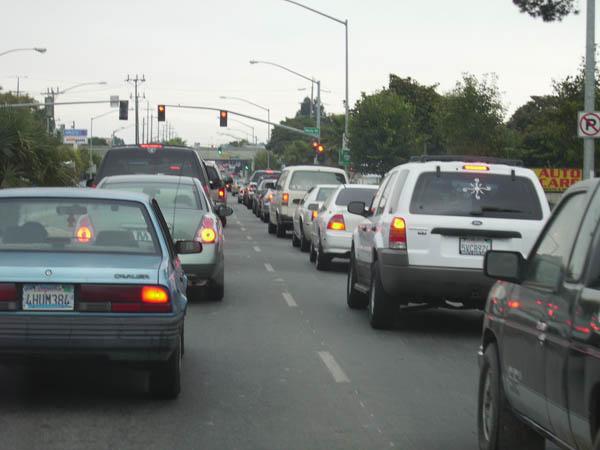
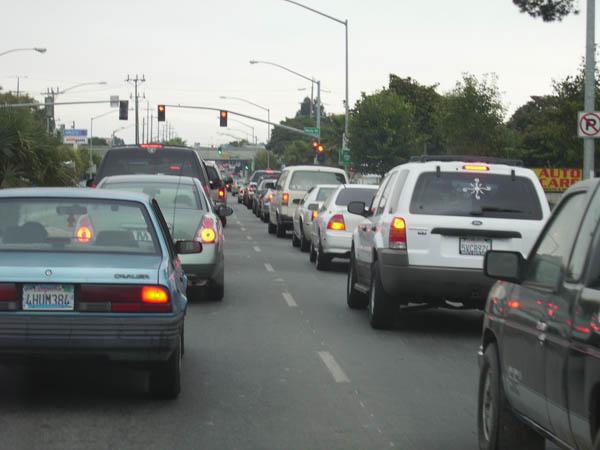
After nearly two minutes of idling, the first car in a long row revs its engine and presses forward. Other cars follow its lead. They slowly gain momentum: 10, 15, 20 miles per hour.
Meanwhile, at the next intersection, the traffic light still shines green. But then as the row of cars get halfway down the block, the light burns yellow. And then red.
The first car hits the brakes and rolls to a stop. Other cars in line do the same as the snake of vehicles comes to an achingly predictable halt.
Repeat the idling.
At an increasing number of hours in the day, this is what it’s like to try to make it across many of Salinas’ arterial thoroughfares, which are plagued by a snail’s-pace traffic flow—and sometimes gridlock.
Elvira Melgoza knows this. Everyday, the Salinas woman in her 70s takes a long walk across much of north Salinas, witnessing thousands of cars maneuvering around town.
“Twenty years ago, we used to say you could get anywhere in Salinas in only 10 minutes,” says Melgoza, who has lived in Salinas for decades. “But those days sure are gone.”
Many drivers now attest how, at certain hours of the day, it can take upwards of 30 minutes or more to get from the one side of the city to the other.
The situation will likely worsen.
The city of Salinas plans to build more than 20,000 homes just north of Boronda Road on unincorporated ag land over the next 15 years. Already, about 150,000 people call Salinas home, making it the most populous city in the county. The new developments will add tens of thousands more people.
While increased traffic is considered to be the natural result of more development—which brings in more people who must drive to get around—not all of Salinas’ growing traffic problem are due exclusively to development.
Much of the traffic problem, says City Councilman Sergio Sanchez, who represents much of East Salinas, has to do with how certain sections of the city are laid out. What’s more, a large chunk of the population already lives in crammed quarters in mostly Eastside neighborhoods where pedestrians are often pitted against cars during rush hour.
“Traffic is a real problem here,” Sanchez says.
Sanchez is sitting in the driver’s seat of a gray Ford Explorer SUV (his wife’s car, he later said) giving a tour of East Salinas’ worst traffic spots.
It doesn’t take long to find them.
“Look, over there!” Sanchez yells, pointing to a man sprinting across busy Sanborn Road as two fast-moving rows of cars and trucks approach the pedestrian. “Out here, it’s survival.”
A few miles later on Towt Street, Sanchez sees a long line of cars that are not moving and are backed up nearly two city blocks.
“They’re all trying to make a left turn onto East Market Street,” Sanchez says, driving past the traffic jam. “It’s like this everyday.”
The reason for the backup is that the street is too narrow to fit a left-turn lane. And the reason for that is this area used to be a section of unincorporated Monterey County, as much of East Salinas used to be, which wasn’t built to Salinas’ infrastructure standards.
“That only makes things worse,” Sanchez says, “because this area still has very small streets and in many places no sidewalks and no infrastructure.”
Sanchez says the City is attempting to solve the problem by adding new amenities like lights and sidewalks, but it’s a challenge.
As for drivers who try to move through Salinas, especially across such oddly designed industrial thoroughfares as those near where Sanborn Road meets Highway 101, there isn’t much that can be done.
But Jose Saucedo is trying. Saucedo is a junior engineer for the City. He’s working on timing traffic signals to reduce wait times for drivers. The changes allow cars to hit all green lights if they’re lucky enough to be there at the right moment.
But even those changes often come at the expense of drivers waiting at lights on side streets, who must often wait longer at red lights.
Saucedo says he often receives complaints from drivers about increasing wait times at traffic lights as congestion increases at intersections like Boronda Road and Highway 101, where 44,000 cars pass through everyday. But he says it’s something that people will have to get used to.
“Yeah, it’s a problem,” he says. “But Salinas is growing and it’s not like you can widen the streets.”
Sanchez says staff is doing what they can, but more must be done. “Think about it,” Sanchez says as he sits at a red light. “What’s going to happen when you bring in nearly 20,000 more homes into Salinas?”
| THE WEEKLY TALLY | 59 |
Percent of California parents recently surveyed who said their children have less interest in the outdoors than they used to, citing television, computers and video games as the main culprits for their child’s disinterest. Source: Pacific Forest and Watershed Lands Stewardship Council “California Summer Youth Survey.” |
|


(0) comments
Welcome to the discussion.
Log In
Keep it Clean. Please avoid obscene, vulgar, lewd, racist or sexually-oriented language.
PLEASE TURN OFF YOUR CAPS LOCK.
Don't Threaten. Threats of harming another person will not be tolerated.
Be Truthful. Don't knowingly lie about anyone or anything.
Be Nice. No racism, sexism or any sort of -ism that is degrading to another person.
Be Proactive. Use the 'Report' link on each comment to let us know of abusive posts.
Share with Us. We'd love to hear eyewitness accounts, the history behind an article.