
In the midst of a historic drought, the California Legislature passed a series of three bills in 2014 that, together, became known as the Sustainable Groundwater Management Act.
SGMA (colloquially, pronounced “sigma”) was the state’s first-ever law aimed at managing its groundwater resources. Before that, California was the last state in the American West to not have laws regarding groundwater management; Texas was second-to-last, after passing such laws in 2008.
“As progressive of a state as we can be, we’re kind of backwards,” says Gary Petersen, director of public works for the city of Salinas, and who’s been heading up the effort to form the Salinas Valley’s groundwater sustainability agency. Petersen is set to become interim general manager of the nascent agency.
Since the 2014 law, a wide range of stakeholders came together to form a joint powers authority, which with the state’s blessing will become the GSA. In total, 25 groups met over 20 times in the last few years, and on March 9, the majority of the new agency’s 11 board members were sworn in.
“As progressive as we can be, we’re kind of backwards.”
The board comprises members of various constituencies – one seat each for Salinas, South County cities, small public water systems, environmental interests and the public, among others – but with four seats, agricultural interests are the most heavily represented. Other seats, like the public one – which is being filled by former county supervisor and dairy farmer Lou Calcagno – also tip the scales toward ag.
Despite that, Petersen says the collaboration was impressive. In describing the process, he throws out the term “one water.” It’s about thinking of all the water in the system – wastewater, groundwater and surface water – as one. “It brings us to a long, ongoing collaborative conversation about the future of water in Monterey County,” Petersen says.
That conversation will be far from simple. Marina Coast Water District has filed to become a GSA in an area that encompasses part of the former Fort Ord – turf the proposed Salinas Valley GSA also intends on claiming. Ultimately, the State Water Board will have to rule on the matter.
Once formed, the GSA must have a sustainability plan ready by Jan. 1, 2020, intended to ensure, according to the law, a “sustainable yield” for the groundwater basin by 2040. In this context, “sustainable” means not having significant “undesirable results” like dropping groundwater levels or degradation of water quality. What exactly that all means is subjective.
County Administrative Officer Lew Bauman has been involved in the process of developing the new water agency, and speaks to some of the complexities ahead.
The goal of the sustainability plan, he says, is to ensure, as much as possible, the same “natural environment that would occur without anthropogenic uses” – despite the Salinas Valley being an intensively used agricultural and residential region, reliant on pumping groundwater for everything from irrigation to industrial lettuce-washing facilities to household sinks.
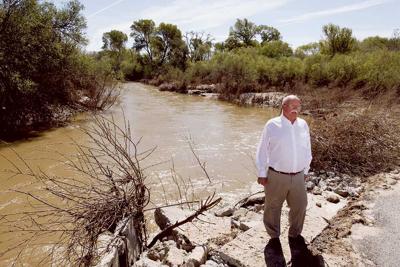
The Salinas Valley has wet years and dry years, and with respect to short-lived flows – like the Salinas River, which is often a dry riverbed – it remains unclear how they should be managed under the new law.


(0) comments
Welcome to the discussion.
Log In
Keep it Clean. Please avoid obscene, vulgar, lewd, racist or sexually-oriented language.
PLEASE TURN OFF YOUR CAPS LOCK.
Don't Threaten. Threats of harming another person will not be tolerated.
Be Truthful. Don't knowingly lie about anyone or anything.
Be Nice. No racism, sexism or any sort of -ism that is degrading to another person.
Be Proactive. Use the 'Report' link on each comment to let us know of abusive posts.
Share with Us. We'd love to hear eyewitness accounts, the history behind an article.