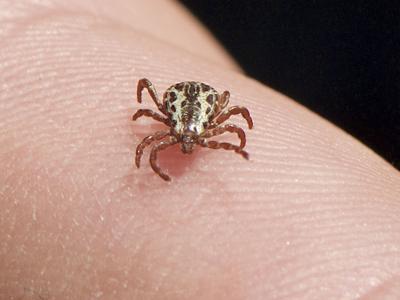

A study published in June concluded that the Central and Northern California coasts have a larger tick and Lyme disease problem than previously realized. The team of researchers, led by the University of Colorado’s Dan Salkeld, found the chances that a Western black-legged tick is carrying the bacteria that causes Lyme disease is about the same along the coastal scrub as it is within the wooded areas further inland.
The probability is still relatively low, especially in Monterey County. Salkeld says the researchers found ticks throughout Garrapata State Park – “garrapata” is Spanish for tick – but the prevalence of ticks carrying Lyme-causing bacteria is between zero and 4 percent. The prevalence of Lyme in ticks along the coastal scrub in Marin County is between zero and 10 percent. In one 2016 study, ticks collected in Rhode Island, Connecticut and Massachusetts had a 20 – to 30-percent chance of carrying Lyme pathogens.
Coastal scrub is a natural habitat for the fence lizard, which has been found to have the ability to kill the Lyme pathogen in ticks. In a statement, Linda Giampa, executive director of the Bay Area Lyme Foundation, said the study shows beaches and “lizard habitats” can no longer be seen as tick and Lyme-free havens.
Although the probability of contracting Lyme is still low, Salkeld says the study shows the same tick vigilance is needed when walking through coastal scrub as when hiking through woods. However, researchers did have a difficult time finding younger ticks, known as nymphs, in coastal scrub in Monterey County, which Salkeld says was surprising but is a good sign.
“Nymphs are the problem stage, like teenagers. They’re small so [they] often go undiscovered, and they can transmit the pathogens because they will have picked them up from animals when feeding as larvae,” Salkeld says via email.
According to the California Department of Public Health, Monterey County has had six confirmed cases of Lyme disease between 2010 and 2019, a rate of 0.14 cases per 100,000 residents over the decade. Santa Cruz County reported 84 confirmed cases during the same time.
If you find a tick on you, the Bay Area Lyme Foundations recommends sending it in for testing to determine its Lyme status. Ken Klemme, manager of Monterey County Mosquito Abatement District, which focuses on insect-borne illness control, advises against this. For starters, he says the tick, if found in Monterey County, is likely a dog tick, which doesn’t carry Lyme. Klemme adds that results often take weeks to come back and testing single ticks for Lyme is too vulnerable to false positives and negatives for it to be effective.
Lyme disease is still difficult to detect and accurately diagnose but typically begins with a bull’s-eye rash around the bite and can evolve into long-lasting symptoms including debilitating fatigue and cognitive impairment, according to the U.S. Centers for Disease Control and Prevention.





(0) comments
Welcome to the discussion.
Log In
Keep it Clean. Please avoid obscene, vulgar, lewd, racist or sexually-oriented language.
PLEASE TURN OFF YOUR CAPS LOCK.
Don't Threaten. Threats of harming another person will not be tolerated.
Be Truthful. Don't knowingly lie about anyone or anything.
Be Nice. No racism, sexism or any sort of -ism that is degrading to another person.
Be Proactive. Use the 'Report' link on each comment to let us know of abusive posts.
Share with Us. We'd love to hear eyewitness accounts, the history behind an article.