Opponents of the controversial Rancho San Juan development breathed a sigh of relief back in March, when the Board of County Supervisors voted to place the matter on the Nov. 8th ballot. The 4,000-home development’s opponents had sat through tedious, all-day hearings last December, watched as the supes disappeared into closed-door meetings with project planners, and listened as a flood of last-minute changes kept coming, before the board ultimately approved it by a 3-2 vote. The opponents had braved wind, rain and holiday traffic to collect some 16,000 signatures—nearly twice the number required to put the plan before Monterey County voters—during a three-week period in late December and early January. And they had filed lawsuits to stop the 2,600-acre subdivision, which would be located just north of Salinas.
Then, on March 3, when the supervisors agreed that voters will make the final decision on Rancho San Juan, opponents thought they saw some light at the end of the tunnel.
But that all changed last week, when the supervisors voted to approve another $325,000 worth of consulting work on the project for an “Environmental Impact Report Addenda,” which will look at reducing the size of the subdivision and at a new traffic model. At the May 17 meeting, County Counsel Charles McKee told the supervisors that the new study will address the concerns of many parties who are suing the County over Rancho San Juan, including Caltrans, the city of Salinas, LandWatch, the Save Our Peninsula Committee and nearby property owners.
But Rancho San Juan’s opponents say the County’s got a different agenda. They are worried that once the new environmental studies have been completed, the supervisors will rescind their earlier approval of the project, approve a somewhat scaled-down version of the development, and force cancellation of the November vote.
“They’re trying to undermine the validity of the referendum,” says Julie Engell, who chairs the Rancho San Juan Opposition Coalition. “There’s a huge amount of political momentum generated over Rancho San Juan. They don’t want us to win.”
She complains that the county has already spent about $3 million on the project, and should wait until the November election before spending additional money on new studies.
“They don’t need to spend a third of a million dollars if the project is legally defensible,” says LandWatch’s Gary Patton. “Why spend more money? They either know it isn’t legal—the court is going to throw this EIR out. Or they know the voters are probably going to turn it down.
“They’ve got five lawsuits. They had the referendum. They are working with the developer in the backroom to design a new project. They are not going to let the public vote on this because they know the public will reject it. And what they care about more than anything else is approving this project.”
Indeed, the board majority has long used the threat of litigation from developer Moe Nobari as a reason to approve the project. The same “pending litigation” also allowed the supervisors, the county attorney, and planning staff to spend many hours in closed session—the state’s sunshine ordinance allows public bodies to discuss lawsuits in private. This has prompted Rancho San Juan’s opponents to charge the County with illegally making planning decisions behind closed doors. McKee has denied “discussing how to approve the project or not to approve the project” in closed session.
Nobari has been trying to build on the rolling hills north of Salinas and east of Highway 101 for two decades. In 2001, his successful lawsuit forced the County to process a specific plan for the property.
His piece of Rancho San Juan—the first phase of the development—would include 739 single family homes, 338 multi-family units, 141 guest villas or time shares, commercial use and an 18-hole golf course. Over the years, land-use politics have delayed his plans to build.
Last year Nobari threatened to sue the County again, charging County officials with continuing to stall the project. But he agreed to dismiss his claims of damages, which county officials estimated at upwards of $100 million, if supervisors approved the project by the end of December 2004.
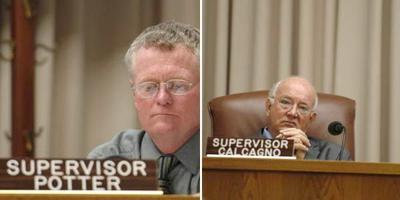
Late last year, by a 3-2 vote, with Supervisors Lou Calcagno and Dave Potter voting against it, the board approved the plan. But the board did agree to revisit Rancho San Juan in about six-months time, which they did on May 17. At last week’s meeting, the approval, with new conditions, passed by a 3-2 vote.
Again, Supervisors Calcagno and Potter cast dissenting votes. They said that they were concerned that the supervisors had not seen a copy of the proposed contract before the meeting. And they questioned spending more money on Rancho San Juan before voters had a chance to weight in.
“I’m being consistent,” Potter said, in a later interview with the Weekly. “I think it’s a dumb project. I’m not interested in spending a third of a million dollars more on that project, I don’t want to shortchange the public’s right to vote.”
When asked if the board majority was maneuvering to pull the project off of the November ballot, Potter said, “I don’t know whether that’s a reality, but it’s certainly a perception.”
Were he a member of the public, Potter said, “I would suspect that these guys are trying to get around us voting on the project.”
Supervisor Butch Lindley, who along with Fernando Armenta and Jerry Smith voted to approve the $325,000 study, said the public will still have its say. “This action doesn’t speak at all to the November ballot,” Lindley said.
“My concern has always been that the economic impact to the county would be tremendous is we don’t go forward with [Nobari’s] portion of the development.”
Armenta also said his vote on May 17 remained consistent with his action in December. “And I could have gone either way back in December. But we were facing a $50 million lawsuit.
“I’m trying to resolve a problem I didn’t create,” Armenta said, referring to the original court order to process a development plan. “Now we’re cleaning up the mess. I’m trying to keep the whole process open and flexible.”
Smith, who campaigned to oppose Rancho San Juan in his successful bid for a supervisor’s seat last year, and who voted to fund the new environmental studies last week, did not return calls.


(0) comments
Welcome to the discussion.
Log In
Keep it Clean. Please avoid obscene, vulgar, lewd, racist or sexually-oriented language.
PLEASE TURN OFF YOUR CAPS LOCK.
Don't Threaten. Threats of harming another person will not be tolerated.
Be Truthful. Don't knowingly lie about anyone or anything.
Be Nice. No racism, sexism or any sort of -ism that is degrading to another person.
Be Proactive. Use the 'Report' link on each comment to let us know of abusive posts.
Share with Us. We'd love to hear eyewitness accounts, the history behind an article.