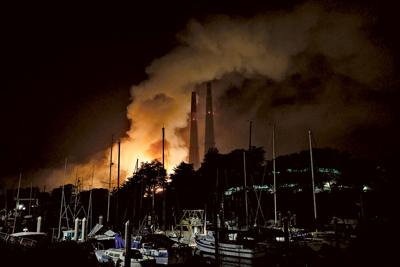

It’s been nearly six months to the day since a Jan. 16 fire consumed Vistra’s 300 megawatt battery energy storage system (BESS) in Moss Landing, a facility known as Moss 300.
Since that time, about 60 percent of the remaining batteries have been “de-linked” – disconnected to reduce their risk of igniting – while the rest remain too dangerous to safely access. The plan to deal with them is being worked on by the U.S. Environmental Protection Agency and Vistra, and involves stabilizing the remaining structure to delink all the batteries still connected.
At the heart of the plan is an agreement still being hashed out between the EPA and Vistra called an “administrative settlement agreement and order on consent” (ASAOC), commonly referred to as “the order.” The order will dictate both EPA’s and Vistra’s respective responsibilities in safely removing and disposing of the batteries, which are damaged to varying degrees.
On May 20, the Monterey County Board of Supervisors sent two letters – one to the EPA, one to Vistra – with a handful of requests to each. Of the EPA, the supervisors asked for clearer communication about the work being done and to collaborate with county staff to give residents trusted data. The supervisors asked Vistra to expedite cleanup, collaborate better with county staff and be respectful of the community.
Vistra responded with a letter reiterating its commitment to the cleanup, while officials from the EPA responded saying, essentially, that the agency’s enforcement agreement with Vistra – the order still being negotiated – is “forthcoming” and will be included on a website devoted solely to the site’s cleanup. It’s a website that, like the order itself, is still in the works. EPA’s response letter also clarified that the agency’s role going forward was “limited to overseeing on-site activities associated with battery removal.”
Kelsey Scanlon, director of the county’s Department of Emergency Management, says the county has struggled to communicate just how complicated and nuanced it has been to plan for the removal of those batteries. It remains unknown how long the cleanup will take – the sheer quantity of the batteries is unprecedented. “I anticipate just the battery removal part will take 10 to 12 months, best-case,” Scanlon says. She doesn’t know how long any additional cleanup might last.
More recently, the county health department sent letters on June 27 to Vistra and on July 3 to PG&E – which owns and operates the Elkhorn BESS in Moss Landing – asking that each update the emergency action plans on file with the county before taking their facilities back online.
Nicki Fowler, the county’s health program coordinator working on the cleanup, says all the state’s soil testing data and analysis of the surrounding area should be done sometime in August, while the water and marsh sediment data and analysis is expected in November. An inclusive assessment of how harmful the site and area remain from a human health perspective, she says, should be done in December.


(0) comments
Welcome to the discussion.
Log In
Keep it Clean. Please avoid obscene, vulgar, lewd, racist or sexually-oriented language.
PLEASE TURN OFF YOUR CAPS LOCK.
Don't Threaten. Threats of harming another person will not be tolerated.
Be Truthful. Don't knowingly lie about anyone or anything.
Be Nice. No racism, sexism or any sort of -ism that is degrading to another person.
Be Proactive. Use the 'Report' link on each comment to let us know of abusive posts.
Share with Us. We'd love to hear eyewitness accounts, the history behind an article.