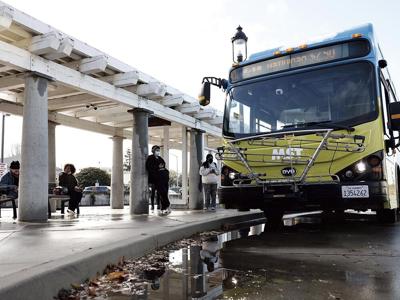

Back in February of this year, the board of Monterey-Salinas Transit approved a comprehensive overhaul of the agency’s transportation network, which promised more efficient transfers and decreased travel times for most of MST’s riders.
Now called the Better Bus Network, the route overhaul goes into effect on Saturday, Dec. 10, and MST workers have been tabling at the transit centers in Salinas and Monterey to educate riders about the impending changes.
Among the most notable changes is that MST will now be honoring transfers for up to two hours after a rider buys a ticket, so those who must take multiple buses to reach their destination will only have to buy one ticket. And the price of a ticket, which now varies depending on the length of the route, will instead be fixed at $2.
Another key change is that routes will be timed to sync up at the transit centers in Salinas and Monterey, where riders needing to transfer can expect to board their next bus within five minutes.
It’s an overhaul Carl Sedoryk, MST’s general manager, says is long overdue. The impetus stems from the pandemic, when ridership plummeted and many MST drivers decided to retire early over health concerns. Yet there remained a steady core of riders through thick and thin, even during the early days of the pandemic.
“One of the things Covid taught us was that even with the hospitality industry virtually shutting down overnight, we still had a million passenger boardings in 2020 – there were people that really needed our services,” Sedoryk says. “That forced us to reexamine: What is our role in this community?”
What MST staff recommended, and its board ultimately approved, was a plan to improve service to the areas with highest ridership, like Salinas and Marina, and to make transferring more seamless. In turn, Sedoryk believes ridership will increase, both because routes are more frequent in areas of highest demand, and because the cost for riders will come down.
MST still has a long way to go to climb back to pre-pandemic levels of ridership: September of this year saw only about 55 percent of ridership compared to September 2019.
Additionally, there are some routes with historically low ridership where service is being curtailed, or in the case of MST’s service to Big Sur, eliminated.
But Sedoryk remains bullish that overall, MST will be better serving those in the community that rely on public transportation the most.


(0) comments
Welcome to the discussion.
Log In
Keep it Clean. Please avoid obscene, vulgar, lewd, racist or sexually-oriented language.
PLEASE TURN OFF YOUR CAPS LOCK.
Don't Threaten. Threats of harming another person will not be tolerated.
Be Truthful. Don't knowingly lie about anyone or anything.
Be Nice. No racism, sexism or any sort of -ism that is degrading to another person.
Be Proactive. Use the 'Report' link on each comment to let us know of abusive posts.
Share with Us. We'd love to hear eyewitness accounts, the history behind an article.