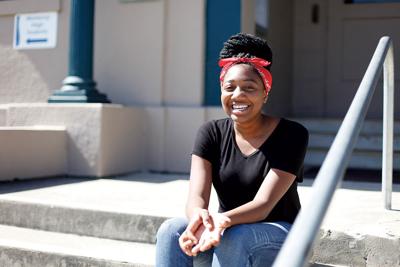

On any given lunch at Monterey High School, students gather in groups on the quad under their favorite oak tree, or sit on their chosen row of stone bleachers by the football field. “Everybody has their spot and their friends,” says 15-year old Dariah Synal, a sophomore. “That’s why it’s hard to be a new kid in high school.”
Synal has been the new kid four times. That’s because her dad, who serves in the U.S. Air Force, was re-stationed repeatedly. Prior to living in Monterey she lived in Utah, where her school was a single building. Monterey High’s campus was different: “My first day, I was scrambling to find my classes.”
About a week in, she got help. Kathleen Burgess, the military liaison for Monterey High and Colton Middle schools, contacted Synal and introduced her to her first real group of friends – a mixture of mostly military with a few established local students, who helped her navigate the hallways and make friends who can help her explore social circles.
Burgess, who served in the Air Force herself, says Synal’s situation is not unique. Most military kids move every two to three years. In Monterey, families tend to stay just 18 months to two years – the time it takes to take a language course or get a degree at the Defense Language Institute or the Naval Postgraduate School. “It’s high turnover,” Burgess says.
At Marshall, La Mesa, Monte Vista elementary schools and Walter Colton Middle, military students account for over 15 percent of the student body. Monterey High has the highest concentration in the district, 23 percent.
Those numbers presents unique challenges: Military families are more likely to experience single-parent households due to deployment or less support because parents are busy focusing on school themselves.
As they change schools, students are more likely to be all over the map when it comes to meeting math and science standards. “I see about half that are caught up or advanced and half that are behind,” Burgess says.
Her position was created in 2015 with a $1.25 million grant from U.S. Department of Defense Education Activity. This year, MPUSD received another DoDEA grant: $1 million to fund five years’ worth of math and science courses designed to help military students catch up or advance in those subjects, and help them in career and college readiness in the long run.
The new programs are still in the works, but some students can expect weekly STEM classes, while others can expect a summer math academy and more on-site tutors.

(0) comments
Welcome to the discussion.
Log In
Keep it Clean. Please avoid obscene, vulgar, lewd, racist or sexually-oriented language.
PLEASE TURN OFF YOUR CAPS LOCK.
Don't Threaten. Threats of harming another person will not be tolerated.
Be Truthful. Don't knowingly lie about anyone or anything.
Be Nice. No racism, sexism or any sort of -ism that is degrading to another person.
Be Proactive. Use the 'Report' link on each comment to let us know of abusive posts.
Share with Us. We'd love to hear eyewitness accounts, the history behind an article.