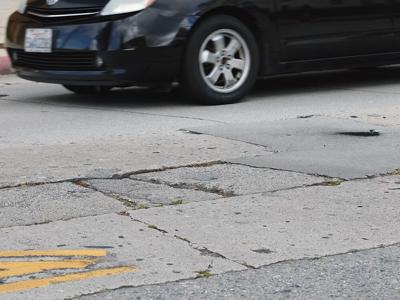

The City of Monterey is broke, and in the coming weeks and months, it will be up to the community, and ultimately the City Council, as to how to go about fixing it.
Such were the contours laid out at a May 6 Monterey City Council meeting, where Public Works Director Andrea Renny highlighted the challenges ahead in funding the maintenance of the city’s aging infrastructure. But before Renny started with her presentation, City Manager Hans Uslar set the table, telling the council that many things the city has long considered assets have in practice become liabilities, properties that generate little to no revenue but come at a cost to maintain.
The city owns 97 facilities totaling 396,000 square feet, must maintain 108 centerline miles of roadway, 100 miles of sewer lines, 44 miles of storm drains and two lift stations, two wharves, a marina, four parking structures, 30 surface lots and 36 parks and open spaces. Its library, police and fire stations were built in the 1950s.
Meanwhile, the amount of money in the city’s general fund available this fiscal year to help pay for all that maintenance is $0. Last year, $2.5 million was available from the general fund for capital improvement projects, just 2.3 percent of the city’s budget. By comparison, Seaside, for example, was able to invest 13 percent of its general fund to that end, while San Luis Obispo allotted 25 percent.
In this current fiscal year, Monterey has $21 million for capital projects, all from restricted funds. The majority ($15.7 million) comes from Measure S, a 1-percent sales tax voters approved in 2018 that expires in March 2027.
Renny said that Measure S, like the four-year Measure P before it, has been critical in bringing the city’s streets up to a “good” rating from “at-risk.” She emphasized that maintaining roads before they further deteriorate saves money long-term – a dollar spent today on maintenance prevents a costlier repair later. In the next five years, Renny said the city’s infrastructure costs will total about $106 million, and for the 25 years after that, about $341 million.
Rafaela King, Monterey’s finance director, will present to City Council on Tuesday, May 20 on possible funding strategies, but Uslar reiterated there would be “no magic bullet,” and that it isn’t a problem that could be solved by sales taxes or bond measures alone.
“We have to ask uncomfortable questions,” Uslar said.




(1) comment
Without knowing all of its assets, perhaps it could sell some? There is already a heft tax on accomodations, how much of that does the city receive? All the other taxes, etc., should leave it well in the black. This looks like it needs a DOGE answer.
Welcome to the discussion.
Log In
Keep it Clean. Please avoid obscene, vulgar, lewd, racist or sexually-oriented language.
PLEASE TURN OFF YOUR CAPS LOCK.
Don't Threaten. Threats of harming another person will not be tolerated.
Be Truthful. Don't knowingly lie about anyone or anything.
Be Nice. No racism, sexism or any sort of -ism that is degrading to another person.
Be Proactive. Use the 'Report' link on each comment to let us know of abusive posts.
Share with Us. We'd love to hear eyewitness accounts, the history behind an article.