
When the dust settled at the end of the annual race to meet the state budget deadline, legislators and Gov. Gavin Newsom produced a $308 billion budget on June 30 for the next fiscal year. One of the big headlines is the so-called Middle Class Tax Refund that could start hitting bank accounts electronically in October. For residents who made $150,000 or less in 2020 it will mean up to $1,050, with smaller refunds distributed to those who made more.
In a county where the per capita income is $32,122 according to the U.S. Census Bureau, that’s good news for individuals and families. Yet beyond the refunds, more money and benefits are headed Monterey County’s way, if not in the coming year then in the year’s following as programs are implemented.
Besides money for social programs, small businesses, schools, roads and other items, the budget includes money targeted at projects specific to Monterey County, like $2.5 million for the Shuman Heart House, a proposed shelter for women and families, and $2 million to the Big Sur Land Trust for the Carmel River Floodplain Restoration and Environmental Enhancement project.
Here’s a summary of some of the issue areas of interest to Monterey County that will likely receive a boost.
Food Assistance
With a stroke of Newsom’s pen, California became the first state to expand food assistance to low-income, undocumented immigrants age 55 and older. It may take a year or more for eligible people to start receiving aid through the California Food Assistance Program as county systems are updated to intake more recipients. Monterey County is expected to be ready sometime in 2024.
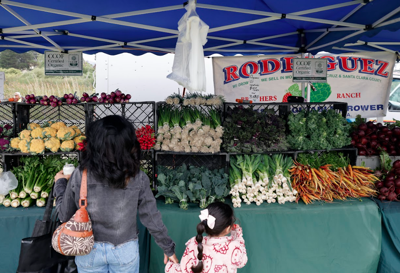
Hester Parker is executive director of the nonprofit Everyone’s Harvest, which manages five farmers markets in the county that provide additional produce to CalFresh recipients (a federal program) through a grant. She says the expansion is a step in the right direction to improving the health of low-income residents, many of whom work in the agricultural industry. “It’s really important that we are providing as much access as possible to fruits and vegetables to the people who feed us,” she says.
Health Care
In another first, by Jan. 1, 2024, California will expand health care access to all residents, regardless of immigration status, through the opening of Medi-Cal to adults between ages 26 and 49. Previously the state opened Medi-Cal to those under 26 and over 50, leaving a gap that will now be closed. That is good news for farmworkers, a largely undocumented workforce.
“Numbering around 162,500, California’s farmworkers are a vital link in the food supply chain for the state and nation,” states a policy brief issued in April by the Public Policy Institute of California. “California’s agricultural sector produced over $50 billion in revenue in 2019; the critical role farmworkers play in the state’s economy underscores the importance of access to health care for these workers, an issue accentuated by the Covid pandemic.”
The budget also includes $352 million over four years to bolster the workforces in behavioral health, public health, primary care and reproductive health. Health workers on the frontlines of the Covid-19 pandemic are expected to receive retention bonuses that total $1.3 billion statewide.
Housing and Homelessness
More than $2 billion has been allocated for housing, services and treatment programs. It includes another $150 million for Homekey projects that renovate properties into permanent housing, and $500 million for rapidly built interim housing for those with serious mental health issues. Money was also set aside for Newsom’s proposed CARE Court, designed to help more people with mental health challenges and substance abuse disorders into permanent housing with support services.
Help for first-time homebuyers in the future was included, with $500 million to seed a program where the state would have a stake in ownership of homes purchased. Once established, an estimated 4,000 buyers would be assisted, with possibly more in the future.
Public Schools
Last year’s education budget broke records, and this year’s includes even more money for local schools. An agreement in this year’s budget increases base funding for the state’s local control funding formula by $9 billion, which is expected to benefit school districts that serve high numbers of English language learners and students who come from low-income families. In addition, there is $8 billion in grants for learning recovery initiatives in the wake of school closures and distance learning during the pandemic. Another $4 billion will go toward before – and after-school programs, as well as summer programs.
Financial Aid
The state will be expanding its Cal Grants program with an initial $500,000 to include 150,000 older students previously excluded. The grants would cover the cost of tuition at public universities and partially cover private institution tuition. They would provide community college students with living grants of approximately $1,650. Another $500,000 is provided for financial aid for nearly all public higher education students.


(0) comments
Welcome to the discussion.
Log In
Keep it Clean. Please avoid obscene, vulgar, lewd, racist or sexually-oriented language.
PLEASE TURN OFF YOUR CAPS LOCK.
Don't Threaten. Threats of harming another person will not be tolerated.
Be Truthful. Don't knowingly lie about anyone or anything.
Be Nice. No racism, sexism or any sort of -ism that is degrading to another person.
Be Proactive. Use the 'Report' link on each comment to let us know of abusive posts.
Share with Us. We'd love to hear eyewitness accounts, the history behind an article.