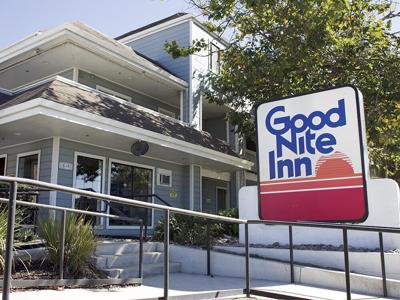

Frank Doss pushes an empty red cart across the parking lot of Good Nite Inn after unloading belongings in his second-floor unit. It’s not a hotel room, but a new home for Doss, who is moving in after being homeless for 12 years since he lost everything in the 2008 recession. He’s one of the first 30 residents of the new long-term housing site in Salinas.
“I’ve got this place with the hopes of turning it into a permanent place for a few years, so I can get everything built back up again,” Doss says.
More than a 100 homeless Salinas residents will have a steady roof over their heads in this building at 545 Work St., thanks to the state program Project Homekey.
After the pandemic hit, Doss enrolled in Project Roomkey, a prior state program that started in March to temporarily house high-risk homeless individuals who were either sick with Covid-19 or needed a place to safely quarantine; Doss is at a high risk because he has chronic obstructive pulmonary disease. If it weren’t for Project Roomkey, he says, “I’d probably still be on the streets.”
Homekey is the state’s second phase to Roomkey, designed to provide permanent housing. The California Department of Housing and Community Development allocated $600 million to municipalities to purchase and adapt motels, hotels and empty apartments into provisional or permanent housing. (Most of those grants come from the state’s CARES Act funds.)
The city of Salinas got $9.2 million to purchase a motel and convert it into temporary housing within 30 days, and into permanent housing in the second year. It’s estimated the total cost will be $17 million.
Salinas was selected because it is home to a disproportionately high number of homeless residents, with one-third of Monterey County’s population and nearly 50 percent of its homeless population, according to the state’s announcement.
By Dec. 17, the first residents like Doss were moving in ahead of Christmas. Salinas Community Development Director Megan Hunter says they have a goal of getting 50 percent of the units occupied within 30 days. Most residents were part of Project Roomkey, or have been referred by other local homeless agencies. There is already a waiting list of 300 people.
Right now, rooms are still designed as motel rooms but will be remodeled into studios with one to two tenants each.
The state will cover the operating costs for the first two years. After that, the county, city of Salinas and local organizations will seek funding. Hunter expects the operating costs, with tenants utilizing housing vouchers, will be approximately $600,000 a year. Step Up on Second Inc., a nonprofit homeless services provider based in Santa Monica, will manage the property.
“We’ll [provide] supportive services to help them transition from living on the streets,” CEO Tod Lipka says, “because all the survival skills on the street are actually counterproductive once you move into housing.”
Homekey took less than six months to start; Hunter and Lipka say this is unprecedented, with projects like this normally taking four to five years.
Doss’ biggest relief is that he has a safe place for his two dogs: “They mean the world to me.”


(0) comments
Welcome to the discussion.
Log In
Keep it Clean. Please avoid obscene, vulgar, lewd, racist or sexually-oriented language.
PLEASE TURN OFF YOUR CAPS LOCK.
Don't Threaten. Threats of harming another person will not be tolerated.
Be Truthful. Don't knowingly lie about anyone or anything.
Be Nice. No racism, sexism or any sort of -ism that is degrading to another person.
Be Proactive. Use the 'Report' link on each comment to let us know of abusive posts.
Share with Us. We'd love to hear eyewitness accounts, the history behind an article.