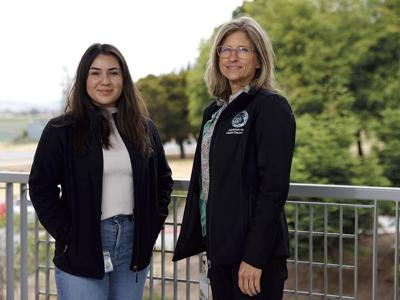

Since January of 2021, the VIDA program has provided resources to the most vulnerable communities in Monterey County. The initiative, launched as a public health effort with $4.9 million in county funds during the Covid-19 pandemic, developed around the idea of reaching people where they are, via community health workers.
It is a system that works, health officials say. “We’re already talking about keeping VIDA as a brand because people recognize it,” says Krista Hanni, a policy manager in the Monterey County Health Department.
Now, using the VIDA framework, a new effort is taking shape. The Farmworker Resource Center will utilize community health workers – within organizations such as Mujeres en Acción, Centro Binacional para el Desarollo Oaxaqueño and Center for Community Advocacy – to communicate about health resources with farmworkers and their families.
Of about 20 community health workers still active in VIDA, up to nine will transition to focusing on farmworkers’ needs starting July 1. “The organizations are out and active and doing their work, and it’ll be a matter of building upon that work,” Hanni says.
Funds come from Assembly Bill 941, signed into law in 2021, which created a matching grant program for counties to establish farmworker resource centers. The state provides 75 percent of funds while counties contribute the remaining 25 percent. (Locally, the state provided $834,000 and Monterey County contributed $208,225, coming from cannabis reserves.)
The model for the bill was Ventura County’s farmworker resource program which started in 2019 and has three offices. They provide services in English, Spanish and Mixteco, an indigenous Mexican language. In Monterey County, community health workers will also provide resources in Spanish, Mixteco, Zapoteco and Triqui.
Sarait Martinez, executive director of the Centro Binacional, says resources in rural areas are scarce and the pandemic highlighted that indigenous populations were overlooked. “We will continue to prioritize our indigenous communities to make sure they have access to information and the resources they need,” she says.
During floods in March, community health workers helped connect Pajaro residents to resources. Hanni says VIDA is an effective framework for emergency response: “We could utilize this model to quickly respond and provide support for our community.”


(0) comments
Welcome to the discussion.
Log In
Keep it Clean. Please avoid obscene, vulgar, lewd, racist or sexually-oriented language.
PLEASE TURN OFF YOUR CAPS LOCK.
Don't Threaten. Threats of harming another person will not be tolerated.
Be Truthful. Don't knowingly lie about anyone or anything.
Be Nice. No racism, sexism or any sort of -ism that is degrading to another person.
Be Proactive. Use the 'Report' link on each comment to let us know of abusive posts.
Share with Us. We'd love to hear eyewitness accounts, the history behind an article.