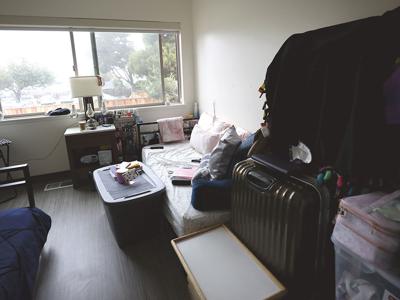

On a recent Monday morning at the Casa de Noche Buena homeless shelter for women and families with children in Seaside, two young brothers are sitting on a couch in the shared living room, with their mother at a table nearby, watching an animated kids’ show featuring bright yellow ducks. The younger of the two, a 1-year-old dressed in Spiderman pajamas, is transfixed by the cartoon. That the family has a safe place to watch cartoons and sleep in warm beds as they search for a permanent home comes after years of pushing by homeless advocates that in 2019 converged with a large influx of cash from Sacramento in hopes of attacking the growing problem of homelessness.
“We decided as a community to ramp up the shelter system,” says Roxanne Wilson, executive director of the Coalition for Homeless Service Providers for Monterey and San Benito counties. That decision was to address the “most urgent need of ‘let’s give someone a place to sleep tonight.’”
The first shelter of its kind on the Monterey Peninsula, Casa de Noche Buena opened in February and it’s already proven to be successful in shepherding people from homelessness to permanent housing. They’ve hosted 32 guests with 13 of those successfully finding a place to live. Casa is a “housing-first” shelter, which means there is a low barrier to entry, regardless of substance abuse, mental health or other issues. Two nonprofits – Community Human Services and Gathering for Women – provide wraparound services, from medical to employment to housing, to assist single women and families, including those with fathers.
The $12 million in Homeless Emergency Aid Program funds that arrived in 2019 to Monterey County from the state went toward the construction of two shelters, Casa and the Salinas Housing Advancement Resources & Education Center, or SHARE, in Salinas near Natividad Medical Center. Casa received $1.3 million to refurbish the former Monterey County health building at the corner of Olympia Avenue and Noche Buena Street. SHARE was awarded $6 million for the new construction facility, a partnership between the city of Salinas and Monterey County. (Remaining funds went to other programs.)
Together the shelters are a big step for Monterey County in temporary housing, but there are still more than 2,400 people estimated to be without homes of their own, based on the 2019 homeless census. Wilson says for every 10,000 people in Monterey County, 58 are homeless, compared to 32 per 10,000 in California. “So we still have a lot of work to do,” she says.
Casa can host between 22 to 36 people at any given time, for up to 90 days, depending on how many families are staying there, and there are over 175 people on the waiting list, according to Elsa Guillen, Casa’s manager. (As of July 12 there were 18 guests; they are limiting the number of guests to 21 in case one room is needed as a Covid-19 quarantine room.)
SHARE – also a housing-first shelter – is able to host up to 102 single guests, less depending on the number of families occupying rooms. (There is also a kennel outside for pets.)
Open since May 31, SHARE staff expect to reach full capacity by July 16, according to Rod Powell, planning manager for the Salinas Community Development Department. The city, county and SHARE operator, Bay Area Community Services, are working on moving guests over from Salinas’ warming shelter, which is in the process of closing.
As beneficial as opening SHARE is, it’s only providing 15 additional shelter beds in Salinas with the closure of the warming shelter, says Lauren Suwansupa, a community affiliation manager for the Monterey County Department of Social Services. “We’re really still fighting to find enough resources for those that are really needing them,” she says.
Prior to Casa and SHARE opening, Wilson says CHSP worked with the Middlebury Institute for International Studies to examine the coalition’s database, looking at which homeless services resulted in the shortest period of need for those services. The data showed combining emergency shelter with rapid rehousing was the most successful in reducing the amount of time and ending a cycle of homelessness. Both Casa and SHARE are employing that combination. “Tying rapid rehousing to emergency shelters makes perfect sense,” Wilson says. “They’re able to grab people in the infancy of homelessness.”
The 13 Casa guests that landed housing found places to live on the open market, but Wilson says the broader housing crisis creates a stiff challenge. “We’re not producing enough housing,” she says. Per a housing market analysis recently released by CHSP, for every 100 extremely low-income households in California there are 24 units available; in Monterey County there are only 16. The likelihood is that more residents on the margins will become homeless. Data shows most people don’t leave the communities they grew up in, they remain even if it means living on the streets.
“I know that’s a hard pill for people to swallow,” Wilson says. “If we don’t do something, we’re just going to see homelessness grow. We’re working so hard on fixing the system, but homelessness is a byproduct of other failed systems.”
There are more shelters in the works but those could take years to develop. Community Human Services purchased a building at 600 E. Franklin St. in Monterey in April for approximately $3 million to create a shelter for women and families within two years. The future Shuman HeartHouse, named after the family that donated the funds, is located in a homeless shelter overlay zone. A capital campaign will soon be underway for improvements, says Robin McCrae, CHS executive director. Wilson says there are plans in the works by other nonprofits to create shelters for youth, including one for LGBTQ+ youth.
“Now that we’ve established these two new shelters the focus is on permanent supportive housing and extremely low-income housing, because ultimately [shelter guests] need somewhere to go after,” Wilson says. “It’s great we’ve created more beds for people to have a safe place to sleep in our community, but what’s next?”
The latest California state budget for 2021-22 provides $12 billion for addressing homelessness and creating approximately 46,000 units of affordable housing. It includes $7 billion to expand Project Homekey, born out of the pandemic after the state created Project Roomkey, which used hotels as temporary shelter housing. Roomkey is set to expire in August, although it’s possible that program could continue, says Suwansupa, who is waiting for word from the state. Project Homekey provides funds to municipalities to purchase hotels for use as permanent supportive housing. Salinas has purchased one hotel and is open to pursuing another once the state releases those funds, Powell says.



(0) comments
Welcome to the discussion.
Log In
Keep it Clean. Please avoid obscene, vulgar, lewd, racist or sexually-oriented language.
PLEASE TURN OFF YOUR CAPS LOCK.
Don't Threaten. Threats of harming another person will not be tolerated.
Be Truthful. Don't knowingly lie about anyone or anything.
Be Nice. No racism, sexism or any sort of -ism that is degrading to another person.
Be Proactive. Use the 'Report' link on each comment to let us know of abusive posts.
Share with Us. We'd love to hear eyewitness accounts, the history behind an article.